
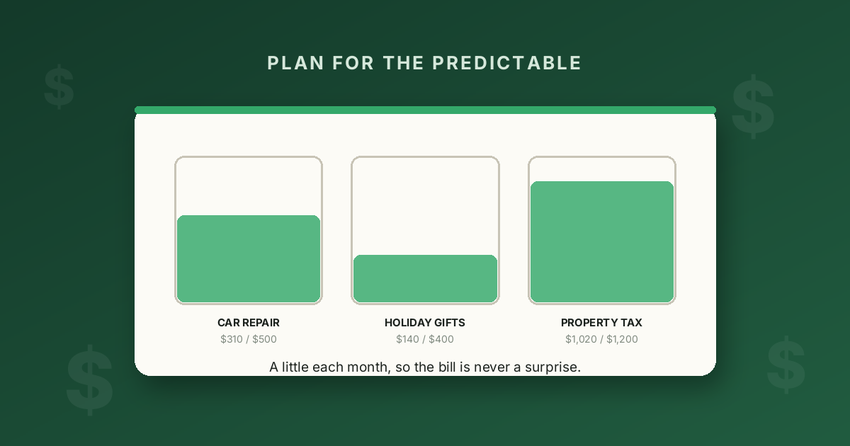
Car registration. Holiday gifts. That dentist visit you've been putting off. None of these expenses are actually surprises — you know they're coming, you just don't know exactly when, so they always seem to hit at the worst possible moment and wreck your budget (or your credit card). There's a simple fix for this, and it's one of the most underrated tools in personal finance: the sinking fund. It's not flashy, it won't make you rich, and you'll never see it trending on social media. But it might be the single easiest way to feel less broke without actually earning more money.
What a Sinking Fund Actually Is
A sinking fund is a small savings pool you build up over time for a specific, known future expense. Instead of scrambling to cover $600 in car repairs the month they happen, you set aside $50 a month for twelve months so the money is already sitting there when the bill arrives. That's really the whole concept. The word "sinking" sounds ominous, but it just means you're gradually "sinking" money into a fund on purpose, a little at a time, so a lump-sum expense never catches you flat-footed.
Where an emergency fund covers the unexpected (job loss, medical emergency, the roof caving in), a sinking fund covers the expected. You know Christmas happens every December. You know your car will eventually need new tires. You know your annual insurance premium is coming. None of that is an emergency — it's just math you haven't done yet.
Why This Matters More Than It Sounds Like It Should
Most people don't go into debt from surprises. They go into debt from predictable expenses they simply didn't plan for in advance. The holidays are the classic example: they happen on the same date every single year, yet millions of people put gifts on a credit card every January because the money wasn't set aside ahead of time. A sinking fund turns a once-a-year financial gut-punch into twelve small, boring, unremarkable transfers.
How to Set One Up
Start by listing the irregular expenses you already know are coming this year — car maintenance, gifts, annual subscriptions, property taxes, an annual pet vet visit, back-to-school costs. For each one, estimate the total and divide by the number of months until it's due. That's your monthly contribution.
You don't need a separate bank account for every single sinking fund, though some people prefer that level of separation for clarity. A simpler approach: one dedicated savings account, with a running note (a spreadsheet, an app, even a sticky note) of how much of the balance is earmarked for what. The money doesn't need to be physically separated to be mentally separated — it just needs to be tracked, so you don't accidentally spend the "car repair" money on something else because it's sitting in the same pile.
Sinking Funds vs. Just "Saving More"
The difference between a sinking fund and generic savings is specificity. Generic savings goals are easy to raid because there's no defined purpose attached — "I'll just dip into savings" feels harmless in the moment. A sinking fund with a name and a due date is psychologically harder to touch for something unrelated, because you already know exactly what it's for and exactly what happens if it's not there when the bill shows up.
Start Small and Specific
You don't need to set up ten sinking funds at once. Pick the one or two irregular expenses that have burned you before — the ones that always seem to show up as a surprise even though they happen every year — and start there. Once the habit sticks, adding more categories is easy.
The expenses were never really surprises. A sinking fund just makes sure your bank account isn't surprised either.