
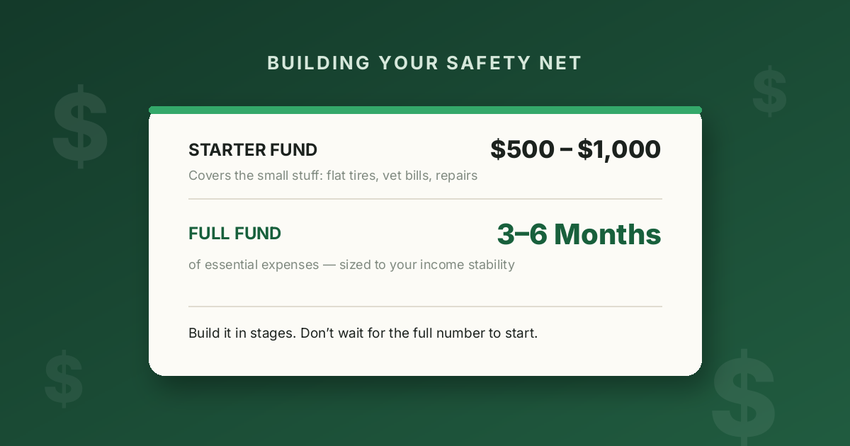
Ask five people how big your emergency fund should be, and you'll probably get five different answers: three months of expenses, six months, a flat $1,000, or "as much as possible." That kind of vague advice is part of why so many people never actually start one. It feels like an impossible moving target, so it gets pushed to "someday." Here's the more useful way to think about it: an emergency fund isn't a single magic number. It's a buffer sized to your actual life, built in stages, that keeps a bad week from turning into a bad year.
Why This Matters More Than It Seems
The real purpose of an emergency fund isn't just "having savings." It's breaking the cycle where an unexpected expense forces you onto a credit card, which then charges interest, which makes next month's budget tighter, which makes you more likely to need the card again. That's how a $400 car repair can quietly turn into $600 or $700 by the time it's paid off. An emergency fund interrupts that cycle at the source. It's the difference between an inconvenience and a crisis.
Start With a Starter Fund, Not the Final Number
If you have $50 in savings, don't let "you need six months of expenses" stop you from doing anything at all. Instead, aim for a starter emergency fund first — commonly suggested as $500 to $1,000. This first tier isn't meant to cover a job loss. It's meant to cover the stuff that actually happens most often: a flat tire, a vet bill, a broken phone screen, a higher-than-expected utility bill.
This smaller goal matters for a psychological reason as much as a financial one. It's achievable in a few months even on a modest budget, and hitting it gives you real proof that saving works for you specifically — not just in theory.
Then Size Your Full Fund to Your Actual Risk, Not a Generic Rule
Once the starter fund is in place, the "how many months" question becomes more personal. If you have stable income, no dependents, and a partner who also earns, three months of essential expenses (rent, utilities, groceries, insurance, minimum debt payments) might genuinely be enough. If your income is variable — freelance work, commission, a single-income household, or a job in an industry prone to layoffs — six months or more gives you real breathing room instead of a false sense of security.
The math only needs to cover essential expenses, not your full current spending. Cut it down to what you'd actually need to keep the lights on and food on the table, and the number gets a lot less intimidating.
Where to Keep It (Briefly)
This money should be easy to reach in a genuine emergency, but not so easy to reach that it becomes a second checking account. A separate savings account — ideally one paying more than a fraction of a percent in interest — is the standard answer, and worth its own closer look if you haven't set one up yet.
Build It on Autopilot
The fastest way to derail an emergency fund is relying on willpower to "remember" to transfer money every month. Automate it instead: a recurring transfer of even $25–50 right after payday, before you see the money in checking, builds the habit without requiring ongoing decisions. Treat it like a bill you pay to your own safety net.
An emergency fund doesn't have to be built in one heroic push. Start small, aim for the starter number first, size the full version to your actual circumstances rather than someone else's rule of thumb, and automate the boring part. That's genuinely most of the work.