
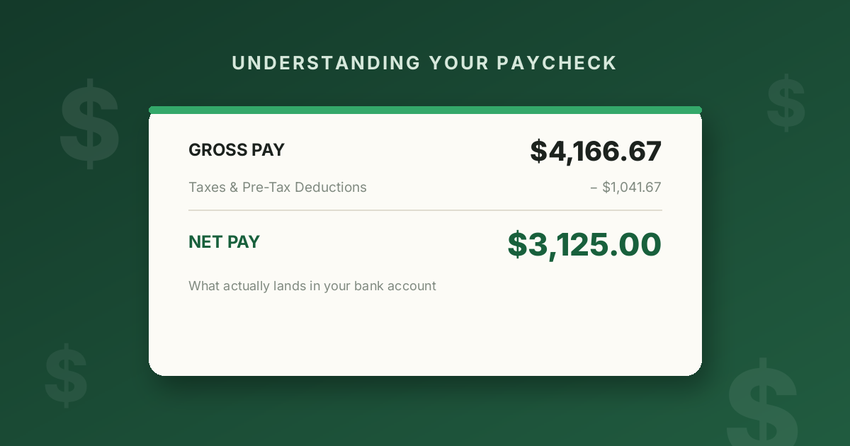
Open your pay stub and you'll see a number at the top that's bigger than what actually lands in your bank account — and a handful of smaller numbers underneath that explain the gap. Most people glance at the final deposit amount and move on, which is fine for day-to-day life but leaves a real blind spot when you're trying to budget, negotiate a raise, or figure out why a $50,000 salary doesn't feel like $50,000 in your checking account. Understanding what's actually on that pay stub is one of the more useful, least-taught pieces of financial literacy.
Gross Pay Is the Headline Number, Not the Real One
Gross pay is your total earnings before anything is taken out — the number in your offer letter, the one you'd quote if someone asked your salary. It's also the number every deduction on your pay stub is calculated from, which is why it matters even though you'll never actually see that full amount hit your account. If you're building a budget directly off your quoted salary divided by twelve, you're budgeting against a number you'll never actually receive — a common reason a "solid" salary can still feel tight every month.
Where the Money Actually Goes: Taxes
The biggest chunk out of gross pay is almost always taxes, and it's worth knowing there are several separate ones stacked together, not one flat cut. Federal income tax is withheld based on the information you provided on your W-4 form — your filing status and any adjustments you claimed — which is why two people with identical salaries can have different take-home pay. Most states (and some cities) layer on their own income tax too, though a handful of states skip it entirely. Then there's FICA: Social Security and Medicare, a combined 7.65% that funds those programs regardless of your income bracket, deducted the same way for nearly every employee.
One detail that trips people up: federal withholding is an estimate, not your actual tax bill. If your W-4 has you over-withholding, you get a refund at tax time — which feels like a bonus but is really just your own money coming back to you, interest-free, months later. Under-withholding means a bill instead. Neither outcome is inherently "wrong," but understanding which one you're set up for is worth five minutes with your W-4 rather than a surprise every April.
Pre-Tax Deductions: The Ones That Actually Lower Your Tax Bill
Some deductions come out of your paycheck before taxes are calculated, which is meaningfully different from deductions that come out after. A traditional 401(k) contribution, for example, reduces the income your taxes are calculated on — contribute $200 and your taxable income drops by $200, so the real cost to your take-home pay is less than $200. Health insurance premiums, HSA and FSA contributions, and some commuter benefits often work the same way. This is why "pre-tax" matters as a phrase, not just as fine print: it's genuinely cheaper to put a dollar into these accounts than to receive that dollar as cash and pay taxes on it first.
Post-Tax Deductions and Take-Home Pay
After taxes and pre-tax deductions are subtracted, you may still see post-tax items: a Roth 401(k) contribution, disability insurance, union dues, wage garnishments if applicable. What's left after all of it is your net pay — the actual deposit amount, and the only number that should really drive your monthly budget.
Why This Is Worth Understanding, Not Just Enduring
None of this changes what you owe, but it changes what you can act on. Knowing your withholding is an estimate means a big refund (or a big bill) is something you can actually adjust via a new W-4, not just something that happens to you. Knowing pre-tax contributions lower your taxable income means a 401(k) increase costs less than it looks like on paper. And budgeting from your real net pay, instead of a gross number you'll never see in full, is the difference between a budget that works and one that quietly fails every month for reasons that never quite make sense.
Your pay stub isn't just a receipt — it's a monthly report on decisions you're allowed to make. Reading it once, carefully, is worth more than most budgeting apps.