
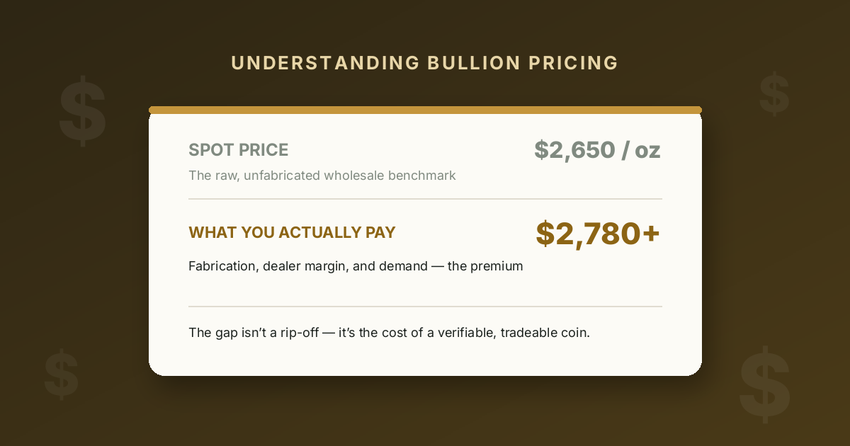
If you've started shopping for your first gold or silver coin, you've probably had this moment: you check the spot price online, then look at what a dealer actually wants for the coin, and the numbers don't match. Not even close, sometimes. Your first thought might be that you're being overcharged. The truth is more nuanced — and understanding it is one of the most useful things a beginner can learn before spending real money on physical metal.
What "Spot Price" Actually Means
Spot price is the current market price for one troy ounce of raw, unfabricated metal — think of it as the wholesale price of the raw material itself. It updates constantly during trading hours based on global supply and demand. But you can't buy "spot price gold" the way you'd buy a stock at the quoted price. Spot price is a benchmark, not a retail price tag. Nobody — not a mint, not a dealer, not a pawn shop — sells finished coins or bars at that number, because turning raw metal into something you can hold, verify, and trust costs money.
Where the Premium Comes From
The difference between spot price and what you actually pay is called the premium, and it isn't arbitrary markup. A few things typically make it up: fabrication costs (someone has to refine, strike, and finish the metal into a coin or bar), dealer overhead and margin (bullion dealers carry inventory, insure it, and need to make a living like any retailer), and distribution (metal moves from refiner to wholesaler to dealer to you, and each step adds a small cost).
Supply and Demand for That Specific Product
This is the part beginners often miss — premiums aren't fixed. When a lot of people want to buy at once (often during economic uncertainty), premiums on popular coins can spike even while the underlying spot price stays flat, simply because dealers can't restock fast enough. A well-known coin like an American Eagle or Canadian Maple Leaf usually carries a higher, steadier premium than generic rounds or bars, precisely because recognizability makes it easier to resell later.
What Counts as a "Fair" Premium
There's no single right number, but there are reasonable ranges depending on the product: widely recognized government-minted coins typically run somewhat higher than generic bars or rounds of the same metal and weight, and silver generally carries a higher percentage premium than gold because fabrication costs matter more relative to a lower per-ounce metal value. The way to actually judge fairness isn't memorizing a target percentage — it's comparing prices across a few reputable dealers for the exact same product. If one dealer's premium is dramatically higher than several others for the identical coin, that's your signal, not some fixed rule of thumb.
A Practical Way to Shop
Before buying, check the live spot price, then compare the all-in price (including any listed shipping or card-processing fees) across at least two or three established dealers for the same specific product. Paying a bit more for a well-known, easily resellable coin is often worth it; paying a dramatically inflated premium for an obscure product is not.
Spot price will always be the headline number you see — but it was never the number you were going to pay. Understanding the premium, and what actually drives it, turns confusing sticker shock into an informed purchase decision.