
Most people know they're supposed to have an emergency fund. Fewer people think carefully about where that money actually sits — and that oversight can quietly cost hundreds of dollars a year. If your "emergency fund" is really just a padded balance in your everyday checking account, you're not doing anything wrong, exactly. But you're leaving money on the table, and you may be making it too easy to dip into savings for non-emergencies. Let's talk about a better home for that cash: a high-yield savings account (HYSA).
Why Checking Accounts Are the Wrong Storage Spot
Checking accounts are built for one thing: easy, frequent access to your money for day-to-day spending. That convenience is exactly the problem when it comes to emergency savings. Two issues show up repeatedly: most checking accounts pay next to nothing in interest — often a fraction of a percent — while inflation quietly erodes the purchasing power of cash sitting idle. And because the money is sitting right next to your spending money, it's psychologically easy to treat it as spending money too.
What Makes a Savings Account "High-Yield"
A high-yield savings account works exactly like a regular savings account — FDIC-insured, no risk to your principal, withdraw whenever you need to — except it pays meaningfully more interest, often many times what a traditional big-bank savings account offers. The difference usually comes down to overhead: online-only banks don't maintain branch networks, so they pass more of that savings back to depositors as interest instead.
The Real-World Difference, in Dollars
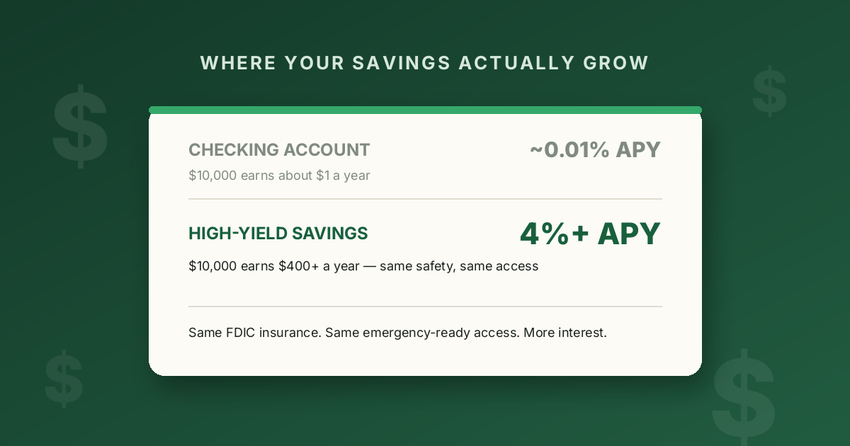
On a $10,000 emergency fund, the gap between a traditional savings account and a HYSA can add up to several hundred dollars a year in interest — money you do nothing to earn beyond picking a better account. Here's what that looks like with current numbers.
As of September 2026, the FDIC puts the national average rate at 0.07% for interest checking and 0.37% for savings, per its national rates release. Top high-yield savings accounts were paying around 4% that same month, with NerdWallet's picks reaching up to 4.21% APY in its August 2026 rate roundup. On $10,000 for one year, roughly:
- Interest checking at 0.07%: about $7
- Average savings at 0.37%: about $37
- A HYSA at 4.00%: about $400
That's around $360 more than the average savings account, and nearly $400 more than checking, for moving the same money. It won't make you rich, but it's real money for zero added risk.
Picture someone with $6,000 of "emergency money" padding their checking account. Moving it to a HYSA at 4% earns about $240 over a year instead of about $4. Same money, same safety, one afternoon of setup.
A Few Things to Check Before Choosing One
Not all HYSAs are equal. Look for FDIC insurance (non-negotiable), no or low minimum balance requirements, no monthly maintenance fees, and easy transfers back to your checking account when you actually need the money — a 1–3 business day transfer is normal and shouldn't be a dealbreaker for money you're not meant to touch casually anyway. That slight friction is a feature, not a bug: it's just enough of a speed bump to stop an impulse withdrawal while still being fast enough for a genuine emergency. Read the fee schedule, too. Some banks still charge for excessive withdrawals or paper statements, the kind of hidden bank fees that can eat a chunk of your interest.
Keeping It Separate Without Losing Access
A HYSA at a different bank than your everyday checking account adds a small extra layer of "out of sight, out of mind" — you won't see the balance every time you check your spending account, which helps it stay an emergency fund rather than a rainy-day slush fund you dip into for non-emergencies. If you're still deciding how big that balance should be, start with sizing your emergency fund.
Confirm the Move Actually Paid Off
Once the money is moved, spend five minutes checking that the account is doing what you opened it for:
- Confirm the insurance. Look the bank up by its legal name in the FDIC's BankFind tool. If you opened the account through an app, the app's disclosures should name a partner bank, and that's the one to look up.
- Check the first interest line. Your first monthly statement should show an "interest paid" or "dividend" line. A quick sanity check is balance × APY ÷ 12. On $10,000 at 4%, that's about $33 for the month. If you see a few cents, you may be in the wrong account tier or under a minimum balance.
- Test a transfer before you need one. Move $20 back to checking and note how many business days it takes. Now you know your real emergency lead time.
- Recheck the rate every quarter. HYSA rates are variable, and banks don't have to warn you before cutting your savings rate. Put a quarterly reminder on your calendar to compare your APY against a couple of competitors.
Mistakes That Undercut a High-Yield Account
- Picking an account for a teaser rate. Some headline rates are temporary boosts that drop after a few months or apply only above a certain balance. Read what the rate falls to afterward.
- Draining checking to zero. Move your emergency fund, not your bill money. Leave enough in checking to cover a month of bills plus a small cushion, or you'll trade interest for overdraft fees.
- Treating it as a second spending account. Linking a debit card or moving money back for nonessential purchases turns it back into the slush fund you were trying to escape.
- Never comparing again. The account that paid 4% when you opened it may pay much less a year later. The fix takes minutes, but only if you look.
Moving your emergency fund into a high-yield savings account is one of those rare personal finance moves that's genuinely low-effort and has no real downside: same safety, same accessibility when it matters, more interest in the meantime. If your emergency fund has been sitting in checking, this is worth fixing today, not "eventually."