
If you call a precious metals dealer and ask about gold, there's a decent chance the conversation eventually steers toward something other than plain bullion coins. You'll hear about a "rare" issue, a "limited mintage," a coin that's "exempt from confiscation" or "not reportable to the government." These are numismatic coins — valued for their rarity and collectible appeal rather than just their metal content — and the pitch usually implies they're a smarter buy than ordinary bullion. For a first-time buyer, that pitch is worth understanding before a phone call, not after a purchase.
Two different products wearing the same disguise
A standard bullion coin — an American Gold Eagle, a Canadian Maple Leaf, a generic 1-ounce round — is priced almost entirely off the spot price of the metal it contains. Dealers add a markup to cover minting, distribution, and their own margin, and that markup is typically small: something like 3% to 8% over spot for a common gold coin, sometimes a bit more for silver, according to dealer pricing guides like USAGOLD's American Gold Eagle buying guide, and more than that during demand spikes. Because the product is standardized, you can compare that markup across dealers in a few minutes online. Even the gap between a brand-name coin and a generic round is a few percentage points, not dozens.
A numismatic coin is priced off something else: its grade, its rarity, how many collectors want that specific date and mint mark. The metal content is almost incidental. Markups on numismatic coins commonly run from about 20% to well over 100% above the coin's melt value; the CFTC's own customer advisory on gold and silver schemes warns that premiums on proof and rare coins can reach 40% to 200% above spot, and that they're "difficult to objectively value." There's no simple way to comparison-shop, because no two numismatic coins are quite the same — a dealer can quote almost any number, and a buyer with no coin-grading background has no easy way to check it.
That difference isn't automatically a scam. Legitimate rare-coin collecting is a real hobby with its own honest dealers and grading services. The problem is a specific sales pattern: coins marketed as an "investment" or "retirement protection" to people who have no interest in numismatics as a hobby and no way to evaluate whether the price they're being quoted bears any relationship to the coin's actual value.
What the markup does to your money on day one
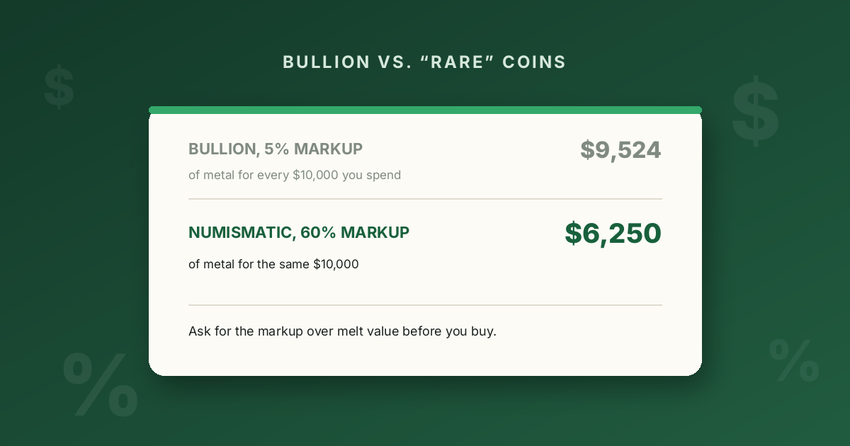
Run the numbers on $10,000. If you buy standard bullion coins with a 5% markup over melt value, you're holding about $9,524 worth of actual metal the moment you walk out the door — a roughly 4.8% embedded cost, similar to a sales commission. If instead you buy numismatic coins carrying a 60% markup, that same $10,000 buys you about $6,250 worth of underlying metal. You've lost 37.5% of your money to the markup before the price of gold or silver has moved at all. At a 100% markup — not unheard of in the cases below — half of what you paid is gone on day one.
To just break even on a 60%-markup purchase, assuming you eventually sell back near melt value (dealers buy back below spot, so this is the generous case), the metal's spot price would need to rise by roughly 60% from where it stood when you bought. That's a very different bet than buying bullion near spot and needing the metal to merely hold its value or tick up.
This isn't hypothetical — it's a recurring enforcement pattern
Regulators have brought this exact case repeatedly. In 2022 the Commodity Futures Trading Commission and 27 state securities regulators charged a Los Angeles-area dealer, Safeguard Metals, in a $68 million fraud targeting the elderly, most of it retirement savings from about 450 customers. According to the CFTC's own press release on the case, the firm sold silver coins with markups that averaged 51% to over 70%, and "nearly every customer suffered an immediate loss" on the purchase — before any market movement — because the coins were worth so much less than the price paid.
The same CFTC advisory describes the pattern behind cases like this: cold calls, emails and infomercials pitching precious metals to people with retirement savings, "tips" about imminent price jumps to rush the decision, and dealers paid commissions on what they sell. It warns never to buy based on a cold call, and notes that "unlike financial professionals who have a fiduciary responsibility to you, these dealers are not obliged to have your best interests in mind."
How to check what you were actually charged
If you've already bought, or you're looking at a quote, you can work out the markup yourself:
- Find the melt value. Look up the coin's pure metal content, which the issuing mint publishes and a reputable dealer lists on the product page or invoice. Multiply it by the spot price on the purchase date. As an example: a coin containing one ounce of gold, bought when spot was $4,200, has a melt value of $4,200.
- Divide what you paid by the melt value. If you paid $6,720, that's $6,720 divided by $4,200, or 1.6: a 60% markup. Anything much above the single-digit range on a common bullion coin deserves an explanation.
- Look up the grade if the coin is in a holder. Coins graded by PCGS or NGC carry a certification number on the label, and both services let you enter that number on their websites to confirm the coin, date, and grade match what you were sold. A coin graded by a company you've never heard of, or "certified" by the dealer itself, hasn't been independently graded.
- Get a buy quote from a different dealer. Ask a second dealer, one with no stake in the original sale, what they'd pay for the coin today. That bid is the closest thing to a real market value, and a gap of thousands of dollars from what you paid tells you what the markup was.
Do this within days of a purchase, while you can still raise it with the seller, and before any second purchase from the same dealer. If you believe you were misled, the CFTC advisory above points to cftc.gov/complaint for reporting.
Pitches worth walking away from
- Features that don't change the metal's value. "Exempt from confiscation" and "not reportable" say nothing about what the gold inside a coin is worth, but you pay for those talking points in the markup.
- Proof or special editions sold as investments. The CFTC advisory's 40% to 200% premium range covers proof coins too. They're made for collectors, and the extra cost rarely comes back when you sell.
- A switch away from what you asked for. If you called about bullion and the conversation keeps steering toward something rarer, ask for a written quote on plain bullion coins and compare the two prices per ounce of metal.
What this means if you're buying
None of this means precious metals are a bad idea or that every coin dealer is running a scheme. It means the product category matters more than the pitch. If your goal is exposure to gold or silver as a small part of a portfolio, standard, widely-traded bullion coins or bars from a mainstream mint are the straightforward way to get it, with a markup you can actually verify against a live spot price before you pay.
A few habits go a long way. Look up the spot price yourself right before any purchase and ask the dealer directly what percentage over spot or over melt value you're being charged — a legitimate bullion dealer will answer that plainly. Be skeptical of any pitch that arrives through a cold call, a late-night ad, or a "retirement protection" seminar, especially one urging you to move an IRA into coins quickly. And if a coin is marketed as rare, limited, or exclusive, treat that as a reason to run the checks above before you pay, not after.