
Most of what beginners learn about buying bullion is about price: what markup is fair, how spot works, when to walk away from a bad quote. Almost none of it addresses a more basic question — is the metal actually gold? For the overwhelming majority of purchases from an established dealer, yes. But counterfeit bullion is a real, documented problem, and the version that matters isn't the crude stuff a home test easily catches. It's a specific method built to defeat exactly those tests.
The tests everyone recommends, and why they're weaker than they sound
Ask around about how to check gold at home and you'll hear the same three things. Weigh it, since gold has a very specific weight for a given size. Try a strong magnet, since gold isn't magnetic and a piece that jumps toward a magnet has iron or steel in it. Balance a coin on a fingertip and tap it — real gold should ring like a bell for a few seconds, while base metals thud and go quiet fast. GoldSilver's rundown of authentication methods covers all three, and they're worth knowing.
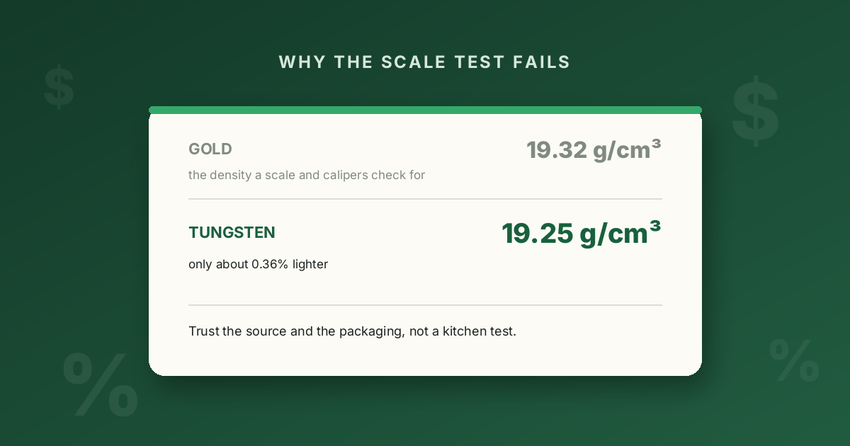
They're also all beatable by a specific trick: tungsten. Tungsten's density is 19.25 grams per cubic centimeter, against gold's 19.32 — a difference of about a third of one percent. A tungsten core machined to the right dimensions weighs almost exactly what a gold bar of the same size should weigh, so the scale test passes. Tungsten isn't magnetic either, so the magnet test passes. The ring test is really a coin test, and it's no help with a bar: a filled bar won't sound obviously wrong to an untrained ear, and a real one won't sound obviously right. The three tests people actually use were never designed with tungsten in mind, and tungsten is used by counterfeiters precisely because its weight slips past them.
This isn't a hypothetical — it happened in Manhattan's diamond district
In September 2012, Ibrahim Fadl, a merchant in Manhattan's Diamond District, drilled into several 10-ounce gold bars he had bought and found gray tungsten inside. According to NBC News's coverage of the discovery, he had paid about $18,000 for each bar, and each was worth only about $3,600 — an 80% loss on every one. Four bars were confirmed as fakes, out of roughly $100,000 of gold he had bought, and the Secret Service investigated. The method, as NBC described it: buy real gold bars, hollow them out, fill them with cheaper tungsten, and keep the outside, the stamps, and the weight looking right. Similar tungsten-filled bars had turned up in England earlier the same year.
That case is more than a decade old, but the underlying economics haven't changed. Tungsten remains cheap relative to gold, and a large bar has enough volume to make hollowing it out and repacking it worth a counterfeiter's time. A small coin doesn't offer the same margin, which is one reason this method concentrates on bars rather than widely-traded government coins.
Why even careful home testing struggles
There is a home test that can, in principle, catch a tungsten core: measuring density directly by water displacement, rather than relying on a magnet or a sound. The math shows why it's a poor fit for a kitchen scale. A one-ounce gold coin (31.1035 grams) has a volume of about 1.6099 cubic centimeters. The same weight of tungsten would occupy about 1.6158 cubic centimeters — a difference of roughly 0.006 cubic centimeters, or a bit over a third of one percent. Catching that reliably means measuring both weight and displaced water volume to a precision most households don't have on hand, and a small measurement error swamps the signal you're looking for.
Professional tools have their own limits. Handheld XRF ("X-ray fluorescence") scanners are common at dealer counters and read the composition of a surface, but by design they only penetrate a shallow layer — commonly cited as somewhere in the tens of microns, according to industrial testing-equipment vendor VRX RF's explainer on spotting tungsten-filled bars. A bar with a gold shell thick enough to cover that depth passes XRF cleanly regardless of what's underneath. Catching a well-made tungsten core reliably takes equipment most dealers don't keep on hand at all: ultrasonic testing, which measures how fast sound travels through the metal (gold and tungsten transmit sound at different speeds even though they weigh almost the same), or eddy-current testing, which reads how the metal responds to an induced electrical field.
What this actually means for a beginner
None of this is a reason to avoid bullion, and it isn't a reason to assume your dealer is dishonest. It's a reason to put the trust where it actually belongs: in where the metal came from, not in a test you can run at your kitchen table. Buying from an established dealer who deals in bars from refiners on the LBMA's Good Delivery List — the industry's accepted standard for refiner quality and chain-of-custody controls — gets you most of the protection, because those refiners' sealed, tamper-evident packaging with an assay card is exactly the kind of thing a counterfeiter would have to defeat, not just a stamp they'd have to copy. If a bar arrives already out of its original assay packaging, or from a private seller instead of a dealer, that's the moment to ask the dealer to run it through their own XRF or, for anything large enough to be worth a counterfeiter's effort, ask about ultrasonic testing before you pay.
It's also worth weighing coins against bars for this specific risk. A one-tenth-ounce coin gives a counterfeiter very little gold to remove and replace before the effort stops paying off, which is part of why widely-traded government coins like American Eagles or Canadian Maple Leafs carry less of this particular risk than large generic bars from less-established sources. That's not the only reason to prefer recognizable coins — they're also easier to resell later, often at a narrower buyback spread — but the counterfeiting angle is one more mark in their favor for a first-time buyer trying to keep things simple.
What to check the day your bullion arrives
None of these steps will catch a well-made tungsten core, but together they catch the cruder fakes and confirm that what arrived is what you paid for. Do them right away, while the dealer's return or dispute process is easiest to use:
- Inspect the packaging before you open the shipping box. For a bar in an assay card, the seal should be intact, with no slits, re-glued edges, or bubbles under the plastic. Photograph it.
- Match the serial numbers. The serial number printed on the assay card should match the number stamped on the bar. If they don't match, photograph both and contact the dealer before doing anything else.
- Weigh and measure against the refiner's published specs. A digital scale that reads to 0.01 gram and an inexpensive caliper will catch a piece that's the wrong size or weight for what it claims to be, even if they can't catch tungsten.
- Use the refiner's verification tool if it has one. PAMP, for example, offers a Veriscan app that compares the surface of a bar with an image recorded when it was made. That catches copied bars, but like XRF it reads the surface, so it's no substitute for intact packaging.
Then file the invoice and photos somewhere other than where the metal is stored. You'll want them for an insurance claim, since homeowners policies cap coverage on bullion unless you schedule it, and again when you sell.
Mistakes that make a fake more likely, or a real bar harder to sell
- Buying from a marketplace or social-media seller because the price is low. Real gold costs the spot price plus a premium everywhere. A bar priced below what dealers charge is priced that way for a reason, and you'll have little recourse if it turns out to be filled.
- Cutting open the assay packaging to test it yourself. You destroy the tamper evidence that made the bar trustworthy, and the next buyer will want to test it again before paying full price.
- Scratch-testing with an acid kit. Like XRF, an acid test only tells you about the surface you scratched, and it leaves a mark that lowers what a buyer will pay.