
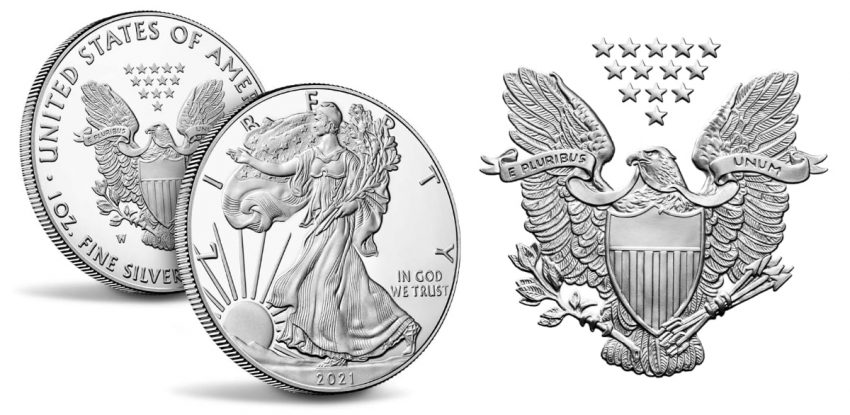
You're on a dealer's website ready to buy some silver. Two products sit side by side: a one-ounce American Silver Eagle and a one-ounce generic silver round from a private mint. Both are .999 fine silver. Both weigh one troy ounce. The Eagle costs several dollars more per coin.
So which do you buy? If you're buying 5 ounces, the gap is lunch money. If you're buying 50, it adds up to real money. The answer depends less on which coin is "better" and more on what happens when you eventually sell, which is where the Eagle earns back part of its premium.
Same silver, different guarantee
Start with what's actually the same. Both coins contain one troy ounce of .999 fine silver. The difference is who stands behind that claim.
The Silver Eagle is a U.S. government coin. The U.S. Mint says each one is one troy ounce of .999 fine silver, with weight and purity guaranteed by the United States government, carrying a $1 face value. The Mint doesn't sell these bullion coins to the public; it distributes them through a network of “Authorized Purchasers”, who sell to dealers, who sell to you. Every layer adds a margin.
A generic round is made by a private mint. A well-known private mint's round is perfectly good silver, but its guarantee is only as strong as that company's reputation, and a buyer years from now may or may not recognize the name.
That recognition is what you're paying for with the Eagle. It's the coin almost every dealer, coin shop, and private buyer in the U.S. knows on sight. If the basic idea of paying over the metal price is new to you, start with why a coin never costs the spot price.
The premium gap, in percentages
Premiums move with demand, so any figure is a snapshot. As of mid-2026, one bullion price-comparison site put typical premiums at about 10–15% over spot for Silver Eagles and 5–10% for generic one-ounce rounds, with dealer buyback prices around spot to $1 over spot for Eagles and spot to $1 under spot for generic rounds. Treat those as ballpark ranges from a single industry source, not a quote you can buy at today.
The important part isn't the exact numbers. It's that the gap on the buy side tends to be much wider than the gap on the sell side.
Running the full round trip: an example
Hypothetical figures. Say silver spot is $60 an ounce. Using premiums within those ranges:
- Silver Eagle at a 15% premium: $60 × 1.15 = $69.00 per coin.
- Generic round at a 7% premium: $60 × 1.07 = $64.20 per coin.
On the way in, the Eagle costs $4.80 more per ounce. On 20 ounces, that's $96.
Now say you sell later, and spot happens to be back at $60. Using the buyback ranges above, a dealer pays $61 for the Eagle (spot + $1) and $59 for the round (spot − $1).
- Eagle round trip: $69.00 − $61.00 = $8.00 lost per ounce, or 11.6% of what you paid.
- Round round trip: $64.20 − $59.00 = $5.20 lost per ounce, or 8.1% of what you paid.
So the Eagle's real extra cost is $8.00 − $5.20 = $2.80 per ounce, not $4.80. On 20 ounces, $56 instead of $96. The better buyback price claws back over 40% of the extra premium.
Breakeven tells the same story. To get your money back on the Eagle, spot has to reach $68 (so that $68 + $1 = $69), a 13.3% rise. For the round, spot has to reach $65.20 (so that $65.20 − $1 = $64.20), an 8.7% rise. The generic round still wins on pure cost per ounce, just by less than the price tags suggest. The dealer buyback spread covers why that sell-side discount exists.
When the Eagle's premium is worth paying
- You might sell to someone other than the dealer you bought from. A local shop or private buyer will know an Eagle instantly. An unfamiliar private-mint round may get a lower offer, or a pass.
- You're buying small amounts. On five coins, the extra $2.80 per ounce in the example is $14. That's cheap insurance for easy resale.
- You plan to hold silver in an IRA. Federal law specifically exempts the Silver Eagle (through its coinage statute) from the “collectibles” rule for IRAs; other bullion qualifies under a separate clause based on fineness and custody by the trustee, per 26 U.S.C. § 408(m)(3). Custodians set their own approved-product lists, so check before buying.
- You want an easy authenticity check. A government coin has published specs to compare against. Counterfeits exist for Eagles too, but an obscure round gives you less to go on. See why home tests can miss a fake.
When generic rounds make more sense
If you're buying a larger amount to hold for many years, plan to sell back to a large dealer that buys generic rounds routinely, and care mainly about ounces per dollar, rounds from a well-known private mint usually come out ahead. Stick with names the major dealers list and buy back, not the cheapest unfamiliar brand.
Check the numbers before you click buy
Before ordering, look at the same dealer's prices for both products on the same day: what they sell each for and what they'll pay to buy each back. Most large dealers post both. Subtract the buyback from the sell price for each coin. That's your real per-ounce round-trip cost, and comparing the two tells you the actual Eagle premium today.
When the order arrives, check the invoice shows the exact product you chose (bullion Eagle, not a proof or special finish) and the price you expected. Then compare the coins to the Mint's published specs: 31.103 grams and 40.60 mm across. Repeat the price comparison every time you buy, because premiums can swing widely within a year.
Mistakes that inflate the Eagle premium
- Paying proof or “special edition” prices for bullion purposes. Proof, burnished, and graded Eagles can cost far more than the bullion version and are priced as collectibles. That's the numismatic markup trap in a familiar-looking coin.
- Comparing only purchase prices. Looking at the sticker gap without the buyback gap overstates the Eagle's real cost, as the example shows.
- Buying the cheapest round from an unknown mint. A tiny discount isn't worth it if a buyer later questions what you're selling.
- Assuming the government coin gets better tax treatment. Silver Eagles and generic rounds are both bullion, and long-term gains on both are generally taxed under the same collectibles rate of up to 28% when you sell.
- Ignoring shipping and payment fees. On small orders, shipping or a card surcharge can add more per ounce than the gap between the two coins.
Check us out on 📺 You Tube 📺
Check out our Media Section: 📺 Media 📺
Silver Eagles vs. Generic Silver Rounds: Is the Brand Premium Worth It?
Discover more from Grow Beyond Green
Subscribe to get the latest posts sent to your email.