
Most explanations of bullion pricing stop at the moment of purchase: spot price, plus a premium, equals what you pay. That's true, but it's only half the transaction. The other half happens later, when you decide to sell, and it works against you in the same direction. Dealers don't buy your coins back at spot either — they pay you less than spot, and the gap between what you paid and what you'd get back is the number that actually determines whether owning physical metal made you money.
Two prices, not one
Every dealer quote has a buy side and a sell side, the same way a currency exchange counter does. The price they'll sell you a coin for sits above spot. The price they'll pay you to buy it back sits below spot. GoldSilver's guide to buyback spreads puts typical gold buyback prices at about 1% to 2% below spot for widely traded government coins, with wider discounts for less liquid products, and notes that silver's spreads run structurally wider than gold's because a lower price per ounce means fixed handling and refining costs eat up a bigger share of the value. Silver also usually carries a higher buying premium than gold, as a percentage of spot, for the same reason.
Put the two together and you get the real cost of a round trip: buy above spot, sell below spot, and the metal has to climb enough in between to cover both gaps before you're ahead at all.
Running the numbers
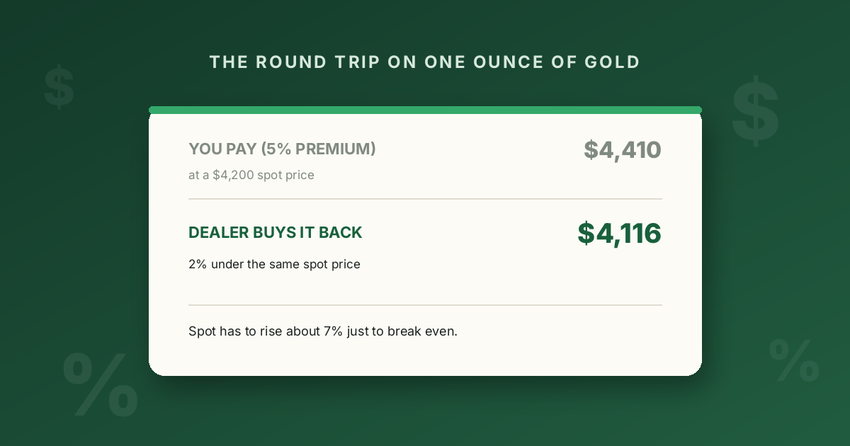
Say gold spot is $4,200 an ounce and a dealer sells you a common bullion coin for a 5% premium — $4,410. If you decided to sell that same coin back the next day, at the same $4,200 spot, and the dealer's buyback discount is 2%, they'd pay you $4,116. You'd be out $294, or 6.67% of what you paid, having done nothing but buy and immediately resell. For spot to merely get you back to even, it needs to rise about 7.1% from where you bought — not 6.67%, because the breakeven price is what spot has to reach so that the new buyback price matches your original purchase price, and that math compounds slightly against you.
Silver's wider spreads make the hole deeper. At $60 spot with a 6% buying premium, you'd pay $63.60. A 4% buyback discount on an unchanged spot price gets you $57.60 back — a 9.4% round-trip loss, needing roughly a 10.4% rise in spot just to break even. That's a meaningfully higher bar than gold clears, for the same holding period and the same intention of just holding metal as a hedge.
None of this means the metal is a bad purchase. It means the premium quoted at checkout was never the whole price of the trade — it was half of it, and the other half only shows up on your way out.
Why the spread exists at all
Dealers aren't padding the buyback discount out of spite. They're managing their own risk and cost structure. A coin they buy back has to be re-verified, sometimes re-melted or re-certified, stored, insured, and eventually resold to the next buyer at their own markup — so their buy price has to leave room for all of that plus their margin. JM Bullion's explanation of dealer buy-back programs notes that spreads also widen for less common or harder-to-verify products, and narrow for widely traded, easily authenticated coins like American Eagles or Canadian Maple Leafs, because those move faster and cheaper through a dealer's inventory. A generic, oddly shaped bar from a small mint you sell back years later may face a wider discount than a well-known government coin sold back the same week you bought it.
Market volatility matters too. When prices are swinging hard, dealers widen both sides of the spread — higher premiums to buy, lower buyback prices to sell — to protect themselves from the risk of re-pricing inventory they're holding between your sale and their next one. Selling during a calm, liquid market tends to land you a tighter spread than selling into a spike or a crash.
Work out your breakeven before you buy, and check it before you sell
Your breakeven spot price is what you paid divided by one minus the dealer's buyback discount. In the gold example, that's $4,410 divided by 0.98, or $4,500: spot has to reach $4,500 before selling back gets you your money. To find it for your own purchase:
- At checkout, get the buy price for the same product. Many online dealers post what they pay for each product next to what they charge; a local shop will quote it over the phone. Divide that buy price by the current spot price to get the buyback discount.
- Write the breakeven on your invoice. You'll want it years from now, along with the receipt itself, which you'll also need for the tax bill when you sell.
- When you're ready to sell, get two or three bids on the same day. Divide each bid by spot at that moment. A bid around 1% to 2% under spot on a common gold coin is in line with the range GoldSilver describes; a bid far below that is a reason to keep calling.
- Ask what comes out of the check. Shipping, insurance, and payment method can each trim what you actually receive, so compare the net amount, not the headline bid.
Ways sellers widen their own spread
- Selling to the first buyer you find. Pawn shops and pop-up "we buy gold" events can pay well below what a bullion dealer will for the same coin. One extra phone call often closes much of the gap.
- Opening, cleaning, or polishing what you own. Breaking the seal on a bar's assay packaging can reduce its resale value, since the buyer has to retest it, and cleaning a coin can leave marks that make it harder to sell. Store metal the way it arrived.
- Losing the paperwork. Without the original invoice you can't prove your cost basis for taxes, and for bars the assay card is part of what a buyer is paying for.
- Assuming rare or collectible coins sell back like bullion. Their spreads are far wider, which is the problem behind the numismatic markup trap.
What this means before you buy
The practical takeaway is to treat the round trip, not the purchase price, as the real cost of the position. Before buying, it's worth asking a dealer directly what they'd pay to buy the same product back today — a legitimate dealer will quote that without hesitation, and comparing it to their sell price tells you the spread you're actually working with. A tight spread on a widely traded coin is a genuinely different product, cost-wise, than a wide spread on something obscure, even if the metal inside is identical.
It also argues for favoring the most liquid, most recognized products if you think there's any real chance you'll sell within a few years rather than holding for decades. The premium may look a little higher upfront on a well-known coin versus a generic round (the brand premium on coins like Silver Eagles is its own calculation), but a narrower buyback spread later can easily make up the difference — and unlike a generic round, you won't be stuck explaining to three different dealers what exactly you're trying to sell them.
Finally, it's a reason to think of an initial bullion purchase as a long-hold decision rather than something to trade in and out of. A stock or an index fund can usually be bought and sold with a spread measured in fractions of a percent. Physical bullion's round-trip cost is an order of magnitude larger, which makes it a poor fit for short-term moves and a more reasonable fit for a position you're comfortable holding through a full market cycle, long enough for price movement to matter more than the spread on either end.