
If you've ever opened a January electric bill and felt your stomach drop, you've probably seen budget billing mentioned as the fix. Most electric and gas utilities offer it: instead of paying whatever you actually used that month, you pay the same amount every month, based on an estimate of your yearly usage. No $260 January bill next to a $70 May bill. Just one number, all year.
It's a genuinely useful tool for a lot of households, especially anyone on a fixed income or anyone who budgets paycheck to paycheck and can't absorb a bill that triples in February. But the program has a mechanic built into it that a lot of people sign up without understanding, and it's worth knowing before you enroll rather than after your first annual reconciliation.
How the flat number actually gets set
Your utility looks at your last twelve months of usage (or, if you're new to the address, an estimate based on similar homes) and calculates roughly what you'd spend over a year. Divide that by twelve, and you get your budget billing amount. According to PUCO, Ohio's utility regulator, the budget period commonly runs from August through the following July, and the company sets the number using your usage history and its own projection of energy prices for the year ahead.
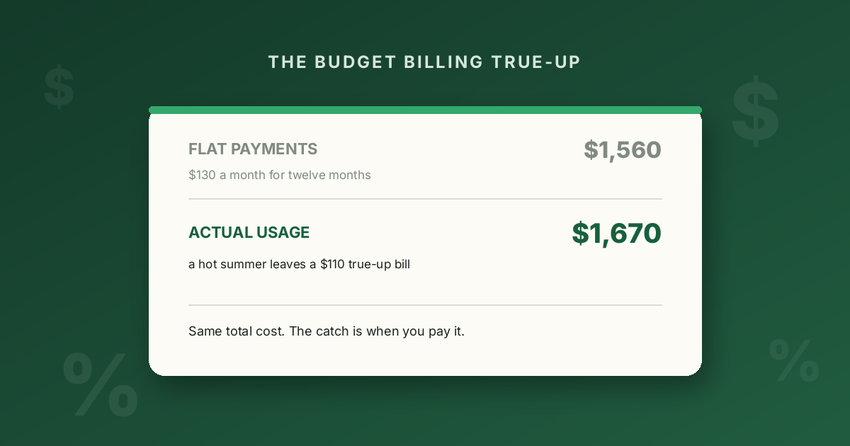
That number isn't a discount. It's not cheaper than paying your actual usage each month — it's the same total cost, just spread evenly instead of following the seasonal curve of your actual heating and cooling. EnergyBot's explainer on budget billing puts it plainly: budget billing doesn't reduce what you pay for energy, it only changes when you pay it.
The true-up is where the estimate meets reality
At the end of the budget period, the utility compares what you actually paid against what you actually used, and settles the difference. This is usually called a true-up. If your estimate ran a little high, you get a credit. If it ran low, you owe the balance, often as a single bill.
Here's a simplified version of how that math plays out. Say your utility sets your budget amount at $130 a month based on last year's usage, so you pay $1,560 over the twelve months. But this year is hotter than average, and a stretch of high air-conditioning months pushes your actual usage higher. If your real monthly bills over the year would have totaled $1,670, the true-up bill at the end of the period is $110 — the gap between what the flat payments covered and what you actually used.
That's not a penalty and it's not the company padding your bill. It's the same total cost you'd have paid either way; it just shows up as one bill instead of being spread across twelve. But if you've mentally filed budget billing as "the amount I pay for electricity," a $110 true-up bill can land the same way a surprise expense would — because for a household that hasn't set anything aside for it, that's exactly what it is.
You're extending a loan, or getting one, without realizing it
In the months when your actual usage would have been lower than your flat payment, you're effectively lending the utility company money interest-free — they're holding cash you haven't used yet. In the months when actual usage runs higher, they're extending you the same kind of interest-free credit. Over a full year those two things are supposed to roughly cancel out, which is the whole point of the program. The imbalance only becomes real money when your estimate turns out to be wrong, which is common in a year with an unusually hot summer, an unusually cold winter, or a change in how much you're home.
There's a second, quieter cost worth knowing about: a flat bill makes it harder to notice when something's actually wrong. A leaking hot-water line, a failing water heater, or a thermostat that's stopped working correctly usually shows up first as an unexplained jump in a monthly bill. On budget billing, that jump gets absorbed into the flat number and doesn't surface until the true-up, months later, by which point the underlying problem has been running the whole time. That's why the actual-usage numbers on your bill deserve a look even when the amount due never changes; the next section shows where to find them.
Read the three numbers on your bill every couple of months
A budget-billing statement usually carries more than the flat amount due. Florida Power & Light's version, for example, prints three figures every month: your actual charges (what you'd owe on regular billing), your budget billing amount, and a deferred balance, which is the running difference between the two. (FPL works that balance off gradually through a rolling average rather than one annual true-up, but the layout is a useful model.) Other utilities use labels like "accumulated balance" or "budget balance," but most show the same idea somewhere on the bill or in your online account.
The deferred balance is the number that predicts your true-up. Using the $130 example above: if, eight months into the budget year, that balance shows your actual charges running $80 ahead of what you've paid, you're on track for a true-up bill, not a credit. Divide the gap by the months left ($80 over four months is $20 a month) and set at least that much aside now, since the gap can keep growing. If the balance runs the other way, you're heading for a credit.
Also compare your usage in kilowatt-hours or therms with the same month last year; many bills chart it. A big jump with no change in weather or household is your cue to look for a leak, a failing appliance, or a thermostat problem before the true-up does it for you. Check again right after the true-up, when your new monthly amount gets set, to make sure it reflects the year you just had.
Mistakes that make the true-up worse
- Enrolling right after an unusually mild year. The flat amount is built from your last twelve months. A cool summer or warm winter sets it low, and a normal year that follows produces a true-up bill.
- Changing the household without asking for a recalculation. An electric vehicle charger, a new space heater, a baby, or starting to work from home all raise usage while your flat amount still reflects the old household. Call and ask whether the utility will recalculate mid-year.
- Spending a true-up credit as found money. A credit means last year's estimate ran high. If this year's usage climbs back up, the next true-up can swing the other way, so the credit is better parked in your buffer.
Deciding if it's worth signing up for
Budget billing solves a real cash-flow problem: it turns a bill that swings by hundreds of dollars across the year into one you can plan around every month. For a household where the seasonal spike would otherwise mean scrambling or falling behind, that's worth something on its own, even though the total yearly cost doesn't change.
Before enrolling, it helps to ask your utility two questions: how often they recalculate your budget amount (some adjust every six months, some annually, and more frequent recalculation means smaller true-up surprises), and what happens to any remaining balance if you move or cancel the plan mid-period, since that balance typically comes due in full rather than staying spread out. And however comfortable the flat number feels, it's worth keeping a small buffer set aside — even $20 or $30 a month — against the possibility that your true-up lands as a bill rather than a credit; a small sinking fund is built for exactly this, and noting the true-up month on a bill calendar keeps it from arriving as a surprise. If your income itself swings from month to month, a flat utility bill also pairs well with budgeting off your slowest month. The program is designed to make your utility costs predictable. Treating the flat amount as the true cost, instead of an estimate that gets settled later, is the part that catches people off guard.