
A couple of years ago you might have opened a savings account advertising 5.00% APY, parked your emergency fund in it, and felt good about the decision. (If you haven't moved yours out of checking yet, here's why it belongs in a HYSA.) If you haven't looked at the account since, there's a decent chance the number on your statement now starts with a 3 or a 4. Nobody called you. No email explained why. The rate just moved.
That's not a mistake on the bank's part — it's how these accounts are built to work, and the rules around telling you are looser than most people assume.
The rate you signed up for was never fixed
"High-yield" savings accounts pay a variable annual percentage yield, meaning the bank can raise or lower it at will, usually in response to what the Federal Reserve is doing with the federal funds rate. When the Fed raises rates, banks compete for deposits by pushing APYs up. When the Fed cuts, banks quietly bring them back down. The Fed cut its benchmark rate three times in 2025, and deposit rates followed it down. The best savings rates, which topped 5% in 2023 and 2024, had slipped to about 4% by mid-2026: in Yahoo Finance's June 3, 2026 rate roundup, the highest rate listed was 4.10% APY, from Bask Bank.
None of this is a secret, exactly. Every savings account disclosure says the rate is variable somewhere in the fine print. But "variable" doesn't register the same way as "your rate could drop by a full percentage point with zero warning," which is closer to what actually happens.
The notice you'd expect isn't required
Banks operate under Regulation DD, which implements the Truth in Savings Act. It requires 30 days' advance notice before a change that could hurt you — a new monthly fee, a higher balance requirement to avoid one, things like that. It's reasonable to assume rate cuts fall under the same protection.
They don't. Regulation DD specifically exempts interest rate and APY changes on variable-rate accounts from the advance-notice requirement, a carve-out confirmed by compliance guidance summarizing the rule's change-in-terms provisions (Bankers Compliance Consulting) and documented in the OCC's own explainer on the statute (OCC). The logic is that a variable rate is, by definition, expected to move — so requiring 30 days' notice every time it does would be impractical for the bank and not especially meaningful for you. Fair enough in principle. In practice, it means the number you saw when you opened the account is a snapshot, not a promise, and the bank has no obligation to flag the day it stops applying.
Why the drop isn't always uniform
Not every bank cuts its rate on the same day or by the same amount. Online banks that built their reputation on chasing the top of the rate tables tend to move fast in both directions — quick to raise when rates climb, quick to cut when they fall, because they're competing on a number that gets published and compared. Traditional brick-and-mortar banks, whose savings customers mostly aren't shopping around, can leave rates low (or lower them slowly) because inertia does the work for them; many big-bank savings accounts still pay a small fraction of a percent regardless of what the Fed does.
There's a second wrinkle worth knowing: some banks run a "new money" or introductory rate that's higher than what existing customers on the same product earn. It's legal, and it means loyalty to a bank you opened a HYSA with two years ago can quietly cost you compared to opening a fresh account today — sometimes at the very same bank.
What the gap actually costs
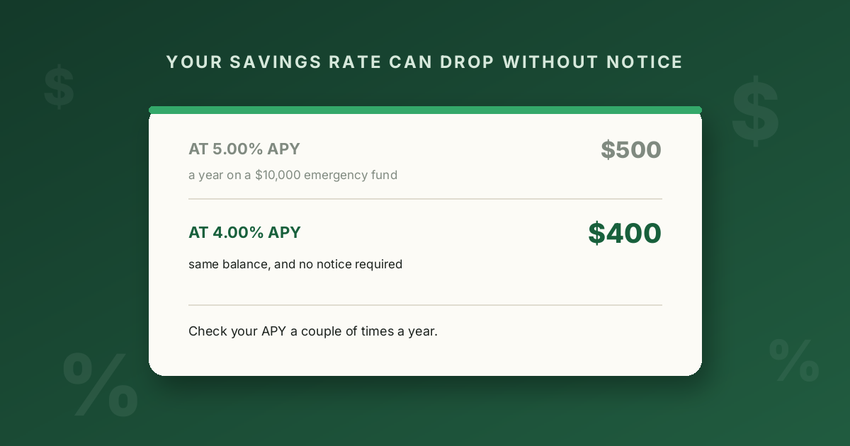
The difference is real money, not a rounding error. On a $10,000 emergency fund, 5.00% APY pays $500 over a year; 4.00% APY pays $400 — a $100 difference, which works out to a 20% cut in what that cash earns you, even though the balance never moved. Scale that to a $25,000 fund and the gap is $250 a year, sitting there unnoticed because nothing about the account looks different — same login, same debit card, same monthly statement format.
Find your real rate on the statement, not in your memory
You don't need to chase the top of the rate tables every month; that's more effort than the payoff justifies for most people. But checking in on your savings rate a couple of times a year is worth the five minutes it takes, and the statement makes it easy. Under the same regulation, a bank that sends periodic statements has to show the “annual percentage yield earned” for the period and the dollar amount of interest you earned, using that exact term.
Open your latest statement and find that line. Then do a quick dollar check: your balance times the APY, divided by 12, should land close to the interest you were paid. As an example, $10,000 at 4.00% should earn about $33 a month; if your statement shows about $25, you're really earning closer to 3%. Next, compare that number with the current APY on your bank's rate page for the same account, and with the rate it's offering new customers.
Put the check on your calendar every six months, and do an extra one a few weeks after the Fed cuts rates, since that's when banks tend to follow.
If your rate has drifted meaningfully below what similar accounts are paying now, that's your cue to act, not a permanent state to accept. Switching to your own bank's new-customer product is sometimes all it takes. And check one or two competing online banks or a rate-comparison site before assuming a move is worth the hassle of updating direct deposits and autopay links — the difference has to be big enough to justify the friction of moving an emergency fund, which should stay easy to access above all else. If you do move, check the first statement at the new bank the same way, and confirm the rate you see is the rate you were promised.
Mistakes when chasing a better rate
- Switching for a teaser rate. Some top-of-the-table APYs are promotional and drop after a few months. Look for an end date or the word "promotional" in the rate details before you move anything.
- Missing a balance requirement. Some accounts pay the advertised APY only above a minimum balance, or only on balances up to a cap, with a lower rate on the rest. Your statement's APY earned will show if that's happening.
- Leaving yourself without access mid-move. Transfers between banks can take a few business days. Keep enough in checking to cover an emergency while the money is in transit.
- Going over the insurance limit when you consolidate. FDIC insurance covers $250,000 per depositor, per insured bank, for each account ownership category. That's well above most emergency funds, but worth checking if you're combining accounts.
- Locking the whole emergency fund in a CD to escape rate cuts. A CD fixes the rate, but early withdrawal penalties make it a poor home for money you might need next week. A CD ladder can work for savings beyond your emergency cushion.
The underlying lesson isn't that high-yield savings accounts are a bad place for cash you need to keep liquid — they're still usually the right tool for an emergency fund. It's that "high-yield" describes the account type, not a fixed number you can stop paying attention to once you've made the deposit.