
Every winter, a chunk of mutual fund investors get a surprise: a tax form showing capital gains, sometimes thousands of dollars' worth, even though their account balance is flat or down for the year. Nothing was sold. No trade was placed. The gain shows up anyway, because the fund itself sold something inside its portfolio and is required to pass the tax bill on to you.
This is one of the more counterintuitive mechanics in ordinary investing, and it only applies outside of retirement accounts. If your funds sit inside a 401(k), traditional or Roth IRA, or HSA, none of this touches you — trades inside those accounts don't create a current tax bill. This is strictly a taxable-brokerage-account issue, and it's one of the reasons where you hold each fund can change your tax bill as much as which fund you pick.
How a fund passes its gains to you
A mutual fund is a pool of money that a manager uses to buy and sell stocks or bonds. When the fund sells a holding for more than it paid, that's a capital gain — but the gain belongs to the fund's shareholders, not the fund itself, so by law the fund has to distribute it to whoever owns shares at the time, usually once a year near the end of December. The IRS confirms that these capital gain distributions are taxable in the year you receive them, and they get reported to you on Form 1099-DIV, generally in Box 2a.
The part that trips people up: it doesn't matter whether you personally held the shares for years or bought them last week, and it doesn't matter whether you took the distribution as cash or had it automatically reinvested. Reinvesting the distribution back into more shares of the same fund does not make it tax-free — you still owe tax on it for that year, and separately it adjusts your cost basis for when you eventually sell.
The trap: buying right before the payout
Here's where it gets genuinely unfair-feeling. If you buy into a fund shortly before its distribution date, you can end up paying tax on gains you never actually experienced.
Say a fund is trading at $50 a share and you put $10,000 in — 200 shares — right before it pays a $3-per-share capital gain distribution. You'd receive $600 in distributions. But the fund's share price (its net asset value) drops by essentially that same $3 on the payout date, since the money that gets distributed is money leaving the fund's assets. So your $10,000 position is still worth about $10,000 right after the distribution — reinvesting the $600 at the new $47 price buys you roughly 12.8 more shares, and the math comes out close to even. You haven't gained anything. But you now owe tax on that $600 as if you had. At a 15% long-term capital gains rate, that's a $90 tax bill for a gain that existed only on paper for a few days. Northwestern Mutual describes this as the classic year-end mistake to avoid.
The fix is simple once you know to look for it: before buying a fund in a taxable account between roughly October and December, check the fund company's website for its estimated distribution date and amount, which most publish in advance. If you're about to make a large purchase and a big distribution is imminent, waiting a few weeks until after the record date avoids the issue entirely.
Why index funds and ETFs mostly sidestep this
This isn't a random flaw baked into all funds equally — it's tied to how much trading happens inside the fund and how the fund is structured.
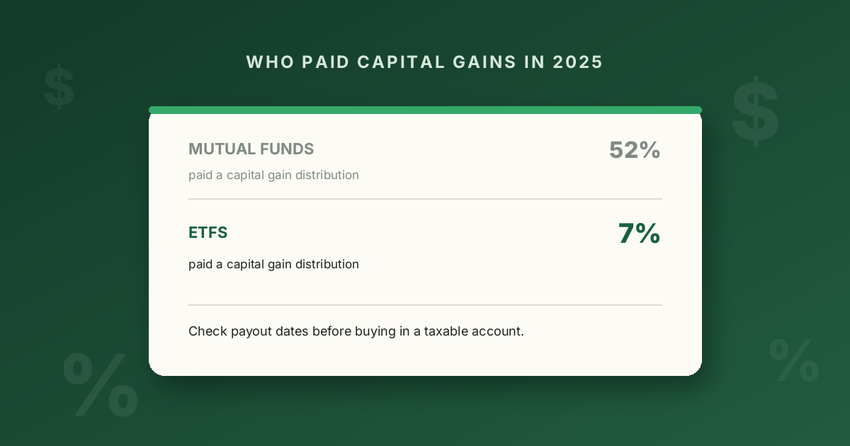
Actively managed funds trade more, so they realize more gains that eventually have to go out the door. Index funds trade only when the underlying index changes, so they tend to generate far fewer taxable distributions. ETFs go a step further: they're built using a mechanism called in-kind redemption, where large institutional investors trade fund shares for a basket of the underlying securities directly, rather than the fund selling assets for cash. That structural quirk lets most ETFs avoid realizing capital gains almost entirely. State Street's research found that in 2025, only about 7% of ETFs distributed capital gains, compared to 52% of mutual funds, and among actively managed funds the split was 9% of active ETFs versus 53% of active mutual funds; for stock funds it was 6% of ETFs versus 57% of mutual funds.
That doesn't mean mutual funds are a bad choice — many retirement accounts default to them (and for most beginners, which account to fund first is a bigger decision than which fund structure), and inside a 401(k) or IRA the distinction is irrelevant anyway. It matters specifically for money sitting in a regular, taxable brokerage account.
What to actually do with this
If you're investing through a taxable account, a few habits handle most of the problem. Favor broad index funds or ETFs over actively managed funds when you have the choice, since lower turnover generally means fewer surprise distributions, and index funds usually come with a lower expense ratio too. Check a fund's distribution history and estimated payout dates before making a large purchase late in the year — most fund companies post this on their website by October or November. And don't panic when the 1099-DIV arrives showing capital gains you don't remember causing; that's normal for mutual fund investors and simply reflects the fund's internal trading, not a mistake in your account.
Check the payout calendar before you buy, and the 1099-DIV after
- Before a late-year purchase: on the fund company's site, find the page for estimated year-end distributions. Note the record date and the estimated capital gain per share, then divide by the share price. Using the example above, $3 on a $50 share is 6%, which means 6% of whatever you invest would come back as a taxable distribution within weeks.
- On the distribution date: look at your position. The share price should have dropped by about the distribution amount, and if you reinvest, your share count should have gone up (12.8 shares in the example).
- When your tax forms arrive: Box 2a of the 1099-DIV should match the capital gain distributions in your brokerage's transaction history for the year.
- In your cost basis view: a reinvested distribution should show up as its own purchase, or tax lot, at the reinvestment price, such as $600 at $47 a share. That added basis is what keeps you from paying tax on the same $600 again when you sell. If it's missing, which can happen with shares transferred in from another brokerage, ask the brokerage to fix it before you sell.
Year-end moves that backfire
- Selling the fund in December to dodge the distribution. Selling realizes your own gain on the shares, which can be far bigger than the distribution you were trying to avoid. Run both numbers first.
- Sitting out the market for months to avoid a small payout. A 0.5% distribution on $10,000 is $50 of taxable gain, or $7.50 of tax at 15%. Waiting a few weeks for a big distribution makes sense; holding cash all autumn over a small one usually doesn't.
- Not setting aside cash for the tax on reinvested distributions. When distributions are reinvested, the tax is due in cash you never received. If Box 2a is large, plan for it before April.
None of this changes whether a given fund is a good long-term holding. It just changes when you buy it and what tax bill to expect along the way.