
Most people who've built up a decent cash cushion eventually run into the same puzzle: the emergency fund is funded, the high-yield savings account is earning a respectable rate, and there's still money sitting around that doesn't quite belong anywhere yet. It's not retirement money. It's not "I need this next month" money. It's the in-between cash — maybe a house down payment three years out, maybe just savings that's grown past what feels necessary for emergencies. I Bonds are one of the few tools built specifically for that gap, and beginners tend to either ignore them entirely or misunderstand what they're actually for.
How the Rate Gets Built
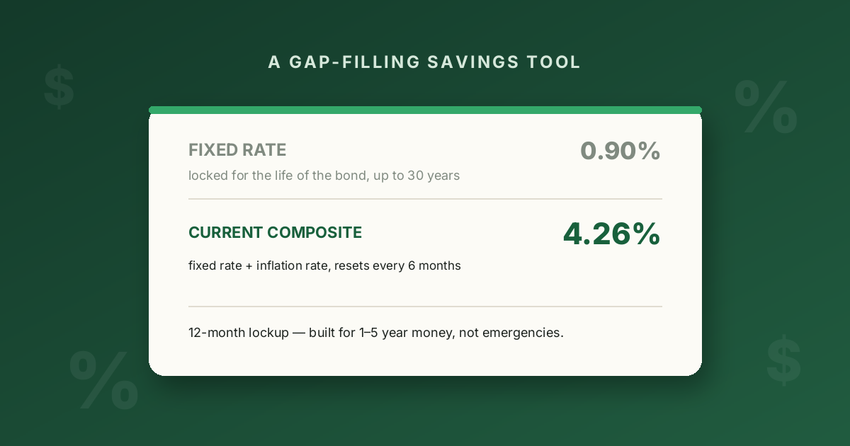
A Series I savings bond isn't a fixed-rate product the way a CD is. Its interest rate is a combination of two pieces: a fixed rate that's locked in for the life of the bond at the time you buy it, and an inflation rate that adjusts every six months based on the Consumer Price Index. Bonds issued between May and October 2026 carry a composite rate of 4.26%, made up of a 0.90% fixed rate and a 3.34% annualized inflation rate, announced twice a year by the Treasury — in May and November — according to TreasuryDirect's official rate announcement. The next rates, for bonds bought November 2026 through April 2027, are due on November 1.
The fixed-rate portion is the part worth paying attention to as a beginner, because it's the only piece that's permanent. Buy today, and your 0.90% fixed rate travels with that specific bond for up to 30 years, even as the inflation component moves up or down every six months. Buy after the next rate reset and you'd get whatever fixed rate is announced then, which could be higher or lower. That's different from a savings account, where the bank can drop your rate the day after you open the account — and doesn't have to warn you first.
The Rules That Actually Matter
I Bonds come with real strings attached, and they're the reason this isn't a replacement for an emergency fund. You can't redeem an I Bond at all during the first 12 months — the money is genuinely locked up. Cash one out between year one and year five, and you forfeit the most recent three months of interest as a penalty. After five years, there's no penalty at all. Purchases are capped at $10,000 per person per calendar year, and since January 1, 2025, I Bonds are sold only electronically through TreasuryDirect, per TreasuryDirect's I bond page. The old option to take up to $5,000 of a federal tax refund as paper bonds no longer exists.
On the tax side, I Bond interest is exempt from state and local income tax, though it's still subject to federal tax — and that federal tax can be deferred until you actually cash the bond in or it matures, rather than paid annually the way savings account interest is. For someone in a high-tax state, that state exemption alone can meaningfully close the gap versus a taxable high-yield savings account paying a similar headline rate.
What $10,000 Actually Earns (and Costs to Cash Early)
Here's a worked example using the current rate. Buy $10,000 of I Bonds in October 2026, and for the first six months the bond earns at a 4.26% annual rate, or about $213. After that, the rate resets based on inflation, so the next six months could pay more or less.
Now compare it to a high-yield savings account at a hypothetical 4.00%, for someone in the 22% federal bracket who also pays a 6% state income tax. Assuming both rates held for a year:
- HYSA: $10,000 × 4.00% = $400 of interest, minus 22% federal and 6% state tax, leaves about $288.
- I Bond: $10,000 × 4.26% = $426 of interest, minus 22% federal tax only, leaves about $332, and that tax isn't due until you cash out.
That's roughly $44 more after tax for the I Bond, before counting the value of deferring the federal tax. The tradeoff is access.
Here's the cost of that tradeoff. Cash the bond in at the two-year mark and you give up the last three months of interest. At a rate around 4.26%, that's roughly $10,000 × 4.26% × 3/12, or about $107. Wait until five years, and the penalty is zero.
Where I Bonds Fit — and Where They Don't
The 12-month lockup and three-month penalty rule out I Bonds for anything you might need on short notice. That's still the job of a high-yield savings account. Where I Bonds earn their place is money with a time horizon of roughly one to five years that you're fairly confident you won't need early — a house down payment fund, a wedding you're saving toward, or simply savings beyond what a realistic emergency fund requires, where the inflation protection and tax deferral are worth more than instant access.
It's also worth sizing expectations correctly: the $10,000 annual purchase cap means I Bonds are a supplement to a savings plan, not the whole thing. Someone saving $30,000 a year toward a house isn't going to fit all of it into I Bonds even if they wanted to. For the rest of that in-between money, a CD ladder can lock in rates on a schedule that matches your goal dates.
Getting Started
I Bonds are purchased directly from the federal government through TreasuryDirect.gov, not through a regular brokerage account, which trips up some first-time buyers expecting to find them alongside their other investments. The account setup takes a few days to verify, so this isn't an instant, same-day purchase the way moving money into a savings account is — worth knowing if you're trying to lock in a specific rate before the next reset.
Timing within the month matters too. I Bonds earn interest from the first day of the month you buy them, so a purchase on the 27th earns the same first month as one on the 2nd. But the issue date is set by the month the purchase actually posts to your account, under Treasury's regulations, so give yourself a few business days of cushion if you're buying near the end of a month or right before a rate change.
How to Check Your Bonds in TreasuryDirect
After you buy, log in and open your current holdings. Here's what to look for and when:
- The issue date. It should be the first of the month you bought, such as October 1, 2026. If it shows the following month, the purchase posted late, and so does the rate you locked in.
- The rate. The bond's detail should show the 0.90% fixed rate and the current composite rate. The composite changes every six months from the issue date, so for an October bond, check again in April and October.
- The current value. For bonds less than five years old, the value TreasuryDirect shows already subtracts the three-month penalty, as TipsWatch explains, so it's what you'd actually get if you cashed out today. The value should rise every month.
- Two calendar dates. Add reminders for the 12-month mark (first day you can cash out) and the five-year mark (when the penalty disappears).
I Bond Mistakes That Eat the Advantage
- Parking your emergency fund in them. For the first year, the money can't come out at all, no matter what happens.
- Cashing out at the end of a month. I Bonds earn interest monthly, and the value only steps up when a new month begins. Redeem on the 28th and you get the same amount as on the 2nd, giving up nearly a month of interest you'd have had by waiting a few days. If you're going to cash out, do it early in a month.
- Treating the composite rate like a CD rate. Only the fixed part is locked in. If inflation cools, the composite rate drops at the next reset, and a CD bought at the same time could end up paying more.
- Forgetting the tax bill bunches up. Deferring federal tax for years means all the interest gets taxed in the year you cash out. Redeeming a large amount in a high-income year can push more of it into a higher bracket.
- Cashing old bonds without checking their fixed rate. A bond bought years ago may carry a higher fixed rate than anything sold today, and that rate is gone for good once you redeem it. Look up each bond's fixed rate before swapping old bonds for new ones.
I Bonds won't replace a diversified investment portfolio, and they're not meant to. They fill a narrow, specific gap: money that needs to outpace inflation and beat a savings account's after-tax return, without taking on stock market risk. For the right time horizon, that's a genuinely useful place for cash to sit.