
If you have a health savings account through work, there's a good chance you've only ever used it the way you'd use a debit card: money goes in from your paycheck, money comes out at the pharmacy counter. That's not wrong, exactly, but it leaves most of the account's value on the table. An HSA isn't just a tax-advantaged way to pay for prescriptions — for a lot of people, it's the best retirement account they have access to, and almost nobody uses it that way.
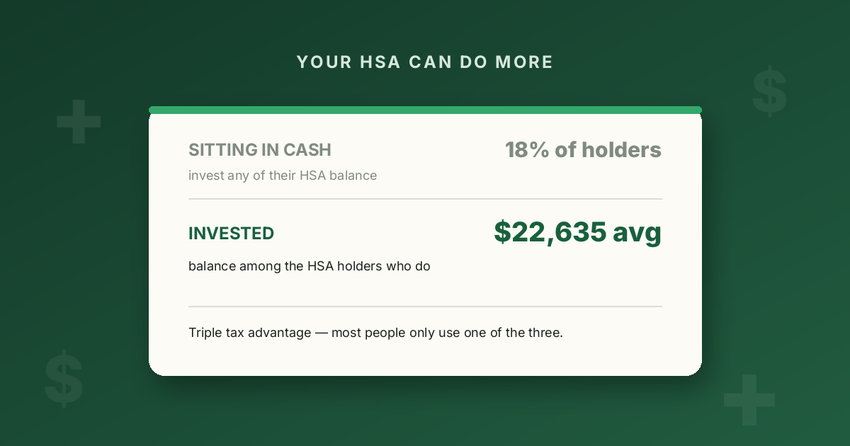
The numbers back this up. Average HSA balances hit a record $5,532 in 2024, but only about 18% of accountholders invested any of that money in assets other than cash — up from just 5% in 2017, but still a small minority. Meanwhile, the accounts that do invest hold an average balance of $22,635. That gap isn't an accident. It's what happens when a tax-advantaged account sits in a 0.01% cash sweep for a decade instead of being put to work.
Why "Triple Tax Advantage" Undersells It
You've probably heard the pitch: HSA contributions go in pre-tax, the money grows tax-free, and withdrawals for qualified medical expenses come out tax-free too. That's true, and it's a genuinely rare combination — a traditional IRA gives you two of those three breaks, a Roth IRA gives you the other two. But the "triple tax advantage" framing makes it sound like a coupon for copays, when the more interesting use case is what happens if you don't spend it.
For 2026, individuals can contribute up to $4,400 to an HSA and families up to $8,750, with an extra $1,000 allowed if you're 55 or older, according to Fidelity's rundown of the new IRS limits. For 2027, the IRS has already raised those to $4,500 and $9,000, with the $1,000 catch-up unchanged, as SHRM reported. Unlike an FSA, none of this expires at year-end — an HSA's balance carries over indefinitely, growing for as long as you leave it alone.
The Strategy Most People Have Never Heard Of
Here's the part that turns an HSA into a real investment account: you don't have to reimburse yourself for a medical expense the same year it happens. If you pay a $400 dental bill out of pocket today but keep the receipt, you can leave that $400 invested in your HSA for ten, twenty, thirty years, then reimburse yourself for the original expense whenever you want — tax-free, no matter how much the investment has grown in the meantime. People who do this systematically are essentially building a second retirement account that's better than either a Roth or Traditional IRA, provided they can afford to pay small medical bills out of pocket now and let the HSA compound untouched.
The one condition: the expense has to come after you opened the HSA. The IRS says expenses incurred before you establish your HSA aren't qualified, so a bill from before your account existed can't be reimbursed later.
What the Difference Looks Like Over 20 Years
Here's a hypothetical. Say you contribute $3,000 a year for 20 years, a total of $60,000.
- Left in a cash sweep at 0.01%: you end with about $60,000. The tax break on contributions is real, but the money never grows.
- Invested at an assumed 6% average annual return: you end with about $110,000. That's roughly $50,000 of tax-free growth from the same contributions.
Now zoom in on that single dental bill. Pay the $400 out of pocket and leave the $400 invested at the same assumed 6% for 25 years, and it grows to about $1,717. You can withdraw the original $400 tax-free at any point with your receipt, and the other $1,317 stays in the account to keep growing or cover later medical costs. Returns aren't guaranteed, and some years will be negative, but over decades the gap between cash and investing is usually large.
What Happens After 65
The account gets even more flexible once you turn 65. At that point, you can withdraw HSA funds for any reason, not just medical ones — the only difference is that non-medical withdrawals get taxed as ordinary income, exactly like a Traditional IRA withdrawal. There's no early-withdrawal penalty at that stage, and unlike a Traditional IRA, an HSA has no required minimum distributions forcing you to pull money out on a schedule. Medical withdrawals stay completely tax-free for life, which matters more than it might sound like — healthcare tends to be one of the largest expense categories in retirement.
How to Actually Turn It On
If your HSA balance is sitting entirely in cash, check with your provider — most now offer a "sweep" feature that automatically moves balances above a set threshold (often $1,000–$2,000) into a menu of mutual funds or index funds once you opt in. The investment options are usually more limited than a full brokerage account, but a low-cost total-market index fund is typically on the list, and that's enough to get the compounding started. Fees matter just as much here as anywhere else, so compare the expense ratios on the menu before picking. The keep-a-cash-buffer-for-near-term-costs, invest-the-rest approach is the same logic as an emergency fund: cover what you're likely to actually spend soon, and let the rest grow.
Confirm Your HSA Is Actually Invested
Turning on investing is often a two-step process, and it's easy to finish only the first step. After you set it up, log in and check:
- The holdings page. You should see fund names with share counts, not just a cash balance. If everything still says “cash” or “deposit account,” the money hasn't moved.
- The sweep threshold and investment election. Confirm the threshold amount you chose and which fund new money goes into. Some providers sweep automatically; others require you to place each purchase yourself.
- Your next statement. It should show a buy transaction in your chosen fund, followed by dividends in later months.
- Your W-2 each January. Box 12, code W, shows your payroll HSA contributions plus anything your employer added. Compare it to that year's limit.
- Your receipts folder. Every out-of-pocket medical bill you plan to reimburse later should be saved with the date, amount, and what it was for. Check the folder each time you pay a bill.
HSA Mistakes That Cost You the Tax Break
- Investing money you'll need for this year's deductible. If you expect $2,000 in bills, keep at least that much in cash. Selling funds after a market drop to pay a hospital bill locks in the loss.
- Losing the receipts. The IRS requires you to keep records showing a withdrawal paid for a qualified expense that wasn't reimbursed elsewhere, per Publication 969. No receipt, no tax-free reimbursement decades later.
- Forgetting employer contributions count toward the limit. If your employer puts in $1,000, your own room drops by $1,000. Excess contributions face a 6% excise tax every year they stay in the account, per the same IRS publication.
- Using it for non-medical spending before 65. Those withdrawals are taxed as income plus an additional 20% tax, unless you're disabled, per Publication 969. That's a steeper hit than most early IRA withdrawals.
- Contributing after you enroll in Medicare. Starting with your first month of Medicare enrollment, your contribution limit is zero, and that includes months covered retroactively, per Publication 969. You can keep investing and spending the balance you already have.
If you're juggling an HSA alongside a 401(k) and a brokerage account, it's also worth thinking about which investments belong in which account, since the HSA's tax treatment is the best of the three.
An HSA that's never been invested isn't doing anything wrong — it's just doing a lot less than it could be.