
Say you bought a handful of one-ounce gold coins back in 2021, tucked them in a safe deposit box, and forgot about them for a few years. Gold's had a good run since then, so you decide to sell. You call a dealer, get a quote, and a week later you're holding a check for a solid profit.
Then tax season arrives, and you find out the IRS doesn't treat that gain like a stock sale. It treats your coins the same way it treats a rare stamp collection or a vintage guitar — as a "collectible" — and collectibles get taxed differently, and less favorably, than almost anything else in a typical investment account.
This catches a lot of first-time bullion sellers off guard, mostly because nobody mentions it at the point of purchase. Here's what's actually going on.
Why gold isn't taxed like a stock
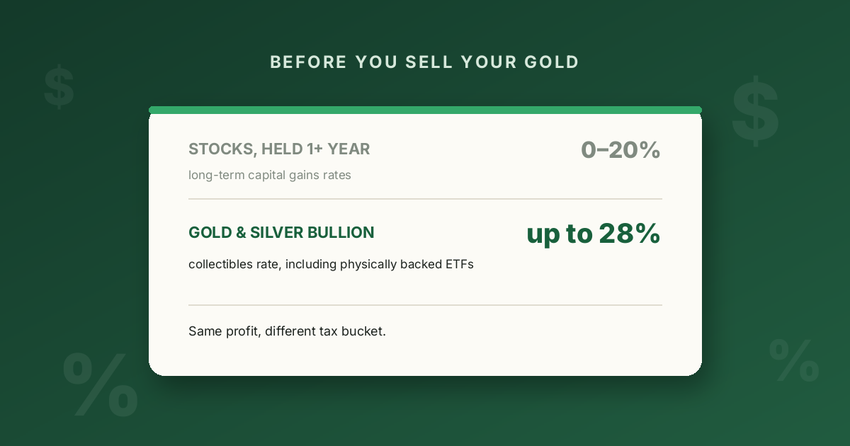
When you sell shares you've held for more than a year, your profit is taxed at the long-term capital gains rate — 0%, 15%, or 20% depending on your income. Physical gold and silver don't get that treatment. Under IRS rules, bullion coins and bars fall into the "collectibles" category, and long-term gains on collectibles are capped at a maximum federal rate of 28% instead of the usual capital gains brackets, according to the IRS's own capital gains guidance. That's not a penalty tacked on for owning metal — it's just how the tax code classifies tangible collectible property, and gold and silver bullion happen to fall into that bucket.
To put it in real numbers: if you're in the 15% long-term capital gains bracket for stocks, the same dollar amount of profit from selling gold coins could be taxed at nearly double that rate. A $10,000 gain that would cost you $1,500 in a brokerage account could cost you up to $2,800 if it came from bullion instead.
28% is a ceiling, not a flat rate
The word "maximum" matters. A long-term collectibles gain is taxed at your ordinary income tax rate, but never higher than 28%. If your ordinary rate is 12%, your bullion gain is taxed at 12%. If it's 22% or 24%, that's what you pay. Only people in the 32%, 35%, and 37% brackets get capped at 28%.
What this means in practice is that the people who get hurt most, compared with stocks, are middle earners. Someone in the 22% or 24% bracket would typically pay 15% on a long-term stock gain, but pays their full 22% or 24% on the same gain from gold. For them, the gap is the whole difference between those two numbers.
Sell within a year and it's ordinary income
The one-year line still applies. If you sell bullion you've held for a year or less, the profit is a short-term gain, taxed as ordinary income at your regular rate — exactly like a short-term stock sale. The collectibles rules only change what happens to gains on metal you've held longer than a year.
A sale from start to finish
Here's a made-up example that puts the pieces together. In 2021 you bought five one-ounce gold coins for $1,900 each, all-in: spot price, dealer premium, shipping, and insurance. Your cost basis is 5 × $1,900 = $9,500.
In 2026 you sell all five back to a dealer at its buy price of $4,100 each, for $20,500. Note that's the dealer's bid, not the spot price you see quoted online, and it's usually lower. Here's why the buyback price trails spot.
- Gain: $20,500 − $9,500 = $11,000, long-term because you held more than a year.
- Tax as a collectible, for a single filer in the 24% bracket: $11,000 × 24% = $2,640.
- Tax on the same gain from a stock fund: $11,000 × 15% = $1,650.
That's $990 more simply because the profit came from metal. And if you'd lost your receipts and could only document, say, a $1,780 spot price per coin, your basis would drop to $8,900, your gain would rise to $11,600, and your tax to $2,784 — another $144 for a missing piece of paper.
Gold ETFs don't get around it
A lot of people assume that owning gold through an exchange-traded fund, rather than as coins in a drawer, turns it into a normal stock investment for tax purposes. For the most popular gold funds, it doesn't. ETFs that hold physical metal in a vault, like SPDR Gold Shares (GLD) and iShares Gold Trust (IAU), are structured as grantor trusts, which means the IRS treats you as owning a slice of the metal itself. Long-term gains on those shares are taxed at the same collectibles rate as physical coins, even though they trade in your brokerage account next to your index funds.
Funds that own gold mining companies, rather than gold itself, are a different story: those are ordinary stock funds and get ordinary long-term capital gains treatment. But they also behave differently from gold, because mining companies have their own costs, debt, and management decisions.
Your cost basis includes the premium you paid
Your taxable gain is the difference between what you sold for and your cost basis — and your basis is what you actually paid, not the spot price on the day you bought. If you paid a dealer premium over spot (and you almost certainly did — we covered why in why a gold coin never costs the spot price), that premium is part of your basis. So are shipping and insurance costs you paid on the purchase.
This is why keeping your receipts matters. If you can't show what you paid, you can't prove your basis, and a gain that's really $3,000 could look like $4,000 on paper.
What the dealer reports — and what it doesn't
When you sell to a dealer, certain transactions trigger a Form 1099-B, which the dealer files with the IRS. The reportable list is narrower than most people expect. According to dealer guidance based on the IRS rules, it includes sales of more than 25 one-ounce Gold Maple Leafs or Krugerrands, gold bars totaling a kilo or more, silver bars totaling 1,000 ounces or more, and bags of 90% U.S. silver coins with more than $1,000 in face value. Many popular items, such as American Gold Eagles, aren't on the list at all.
Separately, if you pay a dealer more than $10,000 in cash, the dealer has to file a Form 8300 cash-transaction report. That's about the cash itself, not about taxing your metal.
Here's the part that trips people up: a sale not being reported to the IRS doesn't make the profit tax-free. You're responsible for reporting every gain on your own return, whether or not a 1099-B was issued. The reporting rules only decide what the dealer has to tell the IRS, not what you owe.
Where the sale should show up on your return
When you file, check that your return actually treats the sale as a collectible. Tax software doesn't always ask, and if it files the gain as an ordinary stock sale, you'll owe the difference later. According to the IRS instructions for Schedule D, which list gold, silver, and platinum bullion and coins as collectibles:
- Form 8949, Part II should list the sale as a long-term transaction (if you held more than a year), with your sale price and your full cost basis, premium and shipping included.
- The 28% Rate Gain Worksheet for Schedule D line 18 should include the gain. If your return shows nothing on line 18 after a bullion sale, the collectible treatment was probably missed.
- If the dealer sent a 1099-B, the proceeds on your Form 8949 should match it. The dealer may not know your basis, so fill that in yourself from your receipts.
Keep the purchase receipt, the sale receipt, and a copy of these forms together. The IRS generally has years to question a return, and your receipts are the only proof of your basis.
A few more things worth knowing
- Losses count too. If you sell bullion for less than you paid, that's a capital loss, and it can generally be used to offset other capital gains.
- Buying may cost you sales tax. Many states exempt precious metals purchases from sales tax, but not all of them, and some only exempt purchases above a certain dollar amount. Check your state's rules before a large purchase, because sales tax is a cost you have to earn back before you're in profit.
- Your state may tax the gain. Most states tax capital gains, including gains on bullion, as regular income. The collectibles cap is a federal rule.
Mistakes that make a bullion tax bill bigger than it needs to be
- Using spot price as your basis. You paid more than spot, and that extra is deductible as part of your basis. Writing down only the spot price overstates your gain, as the example above shows.
- Estimating your profit from spot instead of the dealer's bid. Planning a sale around the spot price makes both the profit and the tax look bigger than they'll be. Get an actual buyback quote before you do the math.
- Assuming a year-and-a-day always saves tax. For most people it doesn't. If your ordinary rate is 28% or below, a long-term bullion gain is taxed at that same ordinary rate, so waiting only helps if you're in the 32% bracket or higher. Check your bracket before delaying a sale just for taxes.
- Selling a large stack in one year. Because collectibles gains are taxed at your ordinary rate (up to the cap), a big gain can push part of it into a higher bracket. Splitting sales across two tax years can keep more of it at a lower rate.
- Thinking “collector” coins escape the rule. Proof and graded coins are collectibles too, and they often carry a bigger markup that you won't recover. Here's why that premium can be so steep.
The bottom line
None of this is a reason to avoid owning gold or silver. Plenty of people hold a small amount of physical metal for diversification or peace of mind, and that's a reasonable choice. It's just worth going in with realistic expectations: the tax on a bullion profit can be noticeably higher than on the same profit from a stock fund, and that difference belongs in your math before you buy, not after you sell. Keep every receipt, know your holding period, and if you're sitting on a large gain, a quick conversation with a tax professional before you sell can be money well spent.
This article is general education, not tax advice. Tax rules change and individual situations vary, so check with a qualified tax professional about your own circumstances.