
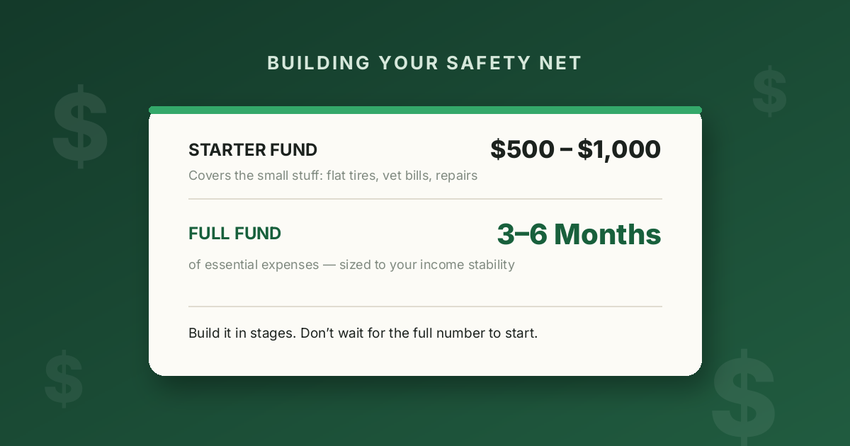
Ask five people how big your emergency fund should be, and you'll probably get five different answers: three months of expenses, six months, a flat $1,000, or "as much as possible." That kind of vague advice is part of why so many people never actually start one. It feels like an impossible moving target, so it gets pushed to "someday." Here's the more useful way to think about it: an emergency fund isn't a single magic number. It's a buffer sized to your actual life, built in stages, that keeps a bad week from turning into a bad year.
Why This Matters More Than It Seems
The real purpose of an emergency fund isn't just "having savings." It's breaking the cycle where an unexpected expense forces you onto a credit card, which then charges interest, which makes next month's budget tighter, which makes you more likely to need the card again. That's how a $400 car repair can quietly turn into $550 or more by the time it's paid off.
Here's the math. Credit card accounts that paid interest averaged a 22.15% rate in May 2026, according to the Federal Reserve's consumer credit data. Put a $400 repair on a card at that rate and pay $15 a month, and it takes about 37 months to clear, with roughly $156 of that going to interest. An emergency fund interrupts that cycle at the source. It's the difference between an inconvenience and a crisis.
Start With a Starter Fund, Not the Final Number
If you have $50 in savings, don't let "you need six months of expenses" stop you from doing anything at all. Instead, aim for a starter emergency fund first — commonly suggested as $500 to $1,000. This first tier isn't meant to cover a job loss. It's meant to cover the stuff that actually happens most often: a flat tire, a vet bill, a broken phone screen, a higher-than-expected utility bill.
This smaller goal matters for a psychological reason as much as a financial one. It's achievable in a few months even on a modest budget, and hitting it gives you real proof that saving works for you specifically — not just in theory. If you can't find even $25 a month right now, start by finding your first $50 a month before worrying about the target.
Then Size Your Full Fund to Your Actual Risk, Not a Generic Rule
Once the starter fund is in place, the "how many months" question becomes more personal. If you have stable income, no dependents, and a partner who also earns, three months of essential expenses (rent, utilities, groceries, insurance, minimum debt payments) might genuinely be enough. If your income is variable — freelance work, commission, a single-income household, or a job in an industry prone to layoffs — six months or more gives you real breathing room instead of a false sense of security.
The math only needs to cover essential expenses, not your full current spending. Cut it down to what you'd actually need to keep the lights on and food on the table, and the number gets a lot less intimidating.
A Worked Example: Sizing One Person's Fund
Here's a made-up example you can swap your own numbers into. Jordan takes home about $3,600 a month, but only part of that is essential. Jordan's must-pay list looks like this:
- Rent: $1,350
- Utilities and phone: $240
- Groceries: $450
- Car and renter's insurance: $220
- Gas and transit: $150
- Minimum debt payments: $190
That adds up to $2,600 a month in essentials, about $1,000 less than Jordan's full spending. Jordan has a steady salaried job and no dependents, so three months is a reasonable target: $2,600 × 3 = $7,800. If Jordan freelanced instead, six months would be $15,600.
Now the timeline. Saving $50 a week (about $217 a month) gets Jordan to a $1,000 starter fund in under five months. After that, bumping the transfer to $300 a month closes the remaining $6,800 in about 23 months ($6,800 ÷ $300). Two years sounds long, but Jordan is covered for a flat tire by month five and for a full month of lost pay about a year in. Every step along the way is protection Jordan didn't have before.
Where to Keep It (Briefly)
This money should be easy to reach in a genuine emergency, but not so easy to reach that it becomes a second checking account. A separate savings account — ideally one paying more than a fraction of a percent in interest — is the standard answer. Here's why a high-yield savings account beats checking for this job.
Build It on Autopilot
The fastest way to derail an emergency fund is relying on willpower to "remember" to transfer money every month. Automate it instead: a recurring transfer of even $25–50 right after payday, before you see the money in checking, builds the habit without requiring ongoing decisions. Treat it like a bill you pay to your own safety net. If you haven't set up a payday transfer before, here's how to automate your savings step by step.
How to Tell Your Fund Is Actually Doing Its Job
A balance going up isn't the whole test. Check these three things:
- Months of coverage, once a month. Divide your savings balance by your monthly essentials. If Jordan has $3,900 saved, that's $3,900 ÷ $2,600 = 1.5 months. The number should rise every month you aren't drawing on the fund.
- The transfer on both statements. Your checking statement should show the automatic transfer going out on the same date each month, and your savings statement should show it arriving. If either is missing, the automation broke.
- The real test: your next surprise bill. When something breaks, did you pay it from savings without your credit card balance growing? If yes, the fund worked. Then restart or raise the transfer to refill what you used.
Recalculate your essentials once a year, and any time you move, change jobs, or add a big fixed bill like a car payment. A target set two years ago at a cheaper apartment may be a month short today.
Mistakes That Keep an Emergency Fund From Working
- Using it for expenses you knew were coming. Car registration and holiday gifts aren't emergencies. Pay for them out of the emergency fund and it's empty when the real one hits. Predictable costs belong in sinking funds.
- Investing it in stocks. A market drop and a layoff often arrive together. Money you may need next month shouldn't be in something that can lose a big chunk of its value in a bad quarter.
- Leaving out irregular essentials. If your car insurance is billed every six months, divide it into a monthly figure and count it. Otherwise your "three months" is really less.
- Not refilling it after you use it. A fund that covered one emergency and was never topped up isn't there for the next one. Treat the refill as your top savings priority until it's back to target.
- Giving up your 401(k) match to save faster. If your employer matches contributions, keep contributing at least enough to get the match while you build the fund. Skipped match money doesn't come back later.
An emergency fund doesn't have to be built in one heroic push. Start small, aim for the starter number first, size the full version to your actual circumstances rather than someone else's rule of thumb, and automate the boring part. That's genuinely most of the work.