
If your income moves around from month to month, a normal monthly budget can quietly work against you. Most budgeting advice assumes a paycheck that lands on the same day for the same amount, twice a month, forever. Freelancers, gig workers, commissioned salespeople, and small business owners don't get that. In the Federal Reserve's latest household survey, 41% of adults who did gig work said their income varied from month to month at least occasionally, compared with 26% of adults who didn't, and many gig workers said they wished the pay were more consistent.
The usual fix people reach for is averaging: add up the last six or twelve months, divide, and budget off that number. It sounds reasonable, but averages hide the exact problem you're trying to solve. Here's a cleaner way to build the plan.
Why averaging quietly fails
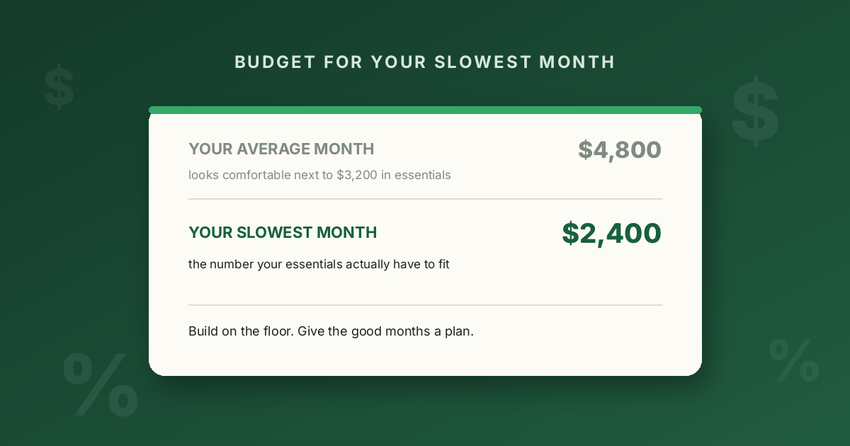
Say your income over the past year averaged $4,800 a month, but ranged from a low month of $2,400 to a high month of $7,200. Your essentials — rent, groceries, insurance, minimum debt payments — come to $3,200. Measured against the $4,800 average, that looks comfortable, and most months it is. But in your $2,400 month, you're $800 short on the bills that can't wait. That gap doesn't show up as a rounding error; it shows up as a missed bill or a credit card balance that doesn't go away.
The fix isn't to earn more in the low months — you often can't control that on short notice. It's to stop budgeting your fixed, non-negotiable costs against an average that assumes every month looks like a typical one.
Budget your essentials off your worst realistic month
Look back at 12 months of income, if you have that much history (three to six months if you're newer to this kind of work). Find the lowest month that wasn't a total outlier — not the month you were in the hospital, but the slowest normal month. That number is your baseline.
Your essential expenses — housing, utilities, minimum debt payments, insurance, groceries, transportation — need to fit inside that baseline. If they don't, that's useful information on its own: it tells you exactly how much your fixed costs need to shrink, or how much cushion you need to build before you can rely on this income alone.
Everything you earn above the baseline in a given month is surplus, and surplus gets a job before it hits your checking account: first to a buffer account (a separate high-yield savings account works well, so the money earns something and stays out of your everyday spending) until that account holds one to two months of the baseline amount, then to taxes (more on that below), then to savings and discretionary spending. Upwork's budgeting guide for freelancers also puts essentials first, before anything else gets funded. It starts from your average income, though; building on your low month instead is the more conservative version of the same idea, and it's the one that holds up when a slow month actually arrives.
This is a different exercise than a sinking fund for an irregular expense like a car repair. A sinking fund answers "how do I save for a cost I know is coming but don't know exactly when." Baselining answers "how do I make sure my rent gets paid when my income itself is the unpredictable part."
Taxes need their own account, not a mental note
If you're self-employed, taxes are the part of irregular-income budgeting that catches people off guard, because nothing is withheld automatically the way it is from a W-2 paycheck. The IRS generally requires quarterly estimated payments if you expect to owe $1,000 or more for the year from self-employment income, and missing those payments can mean an underpayment penalty on top of the tax itself.
A commonly used rule of thumb among freelance tax preparers is to set aside roughly 25% of net self-employment income for combined federal income tax and self-employment tax, adjusting up or down based on your actual bracket, deductions, and state taxes. Self-employment tax alone is 15.3%, covering Social Security and Medicare, and it applies to 92.35% of your net self-employment earnings — on $50,000 of net self-employment income, that's about $7,065 before any income tax is added on top. That's real money, and it's much easier to send a quarterly payment from an account you've already been feeding than to find it in April.
The practical move: open a separate savings account, and every time a payment lands, transfer a fixed percentage into it immediately, before you touch the rest. Treat that account as invisible for everything except tax payments. It's a smaller version of the same principle behind the baseline — take the volatile, easy-to-underestimate obligation and give it its own dedicated, boring holding spot rather than trying to remember to save for it later. If you want a simple structure to hang the buffer and tax accounts on, both slot neatly into a bills, spending, and savings account setup.
How to tell the baseline is holding
The plan is working if three balances behave the way they should. Set a monthly reminder for the day after your rent or mortgage clears, and check these:
- The buffer account. In any month you earned at or above your baseline, the buffer balance should be the same as last month or higher. If it dropped in a month that wasn't slow, spending has crept above your essentials line somewhere, and that line is the thing to look at, not your income.
- Your credit card statement balance. Compare it with last month's. If essentials are landing on the card and the balance keeps climbing even in average months, your baseline is set higher than your real slow months can support.
- The tax account, before each quarterly deadline. Using the 25% example rate, if your net self-employment income is $30,000 so far this year, the tax account plus the estimated payments you've already sent should add up to roughly $7,500. Then confirm the payments actually posted: your IRS Online Account shows up to five years of payment history, including estimated tax payments.
Once a year, or every six months while you're still building history, rerun the baseline. Add the newest months, drop the oldest, and find the slowest normal month again. If it moved, move your essentials target with it.
Mistakes that make a slow month hurt more
- Raising the baseline after one great month. A $7,200 month feels like a new normal. Signing a car loan or a pricier lease on the strength of it pushes your fixed costs above what a $2,400 month can cover, which is the exact gap this method exists to close.
- Borrowing from the tax account to cover a short month. That money is already owed. Spend it on rent and you reach the next quarterly deadline with an empty account and a possible underpayment penalty on top of the tax.
- Counting invoices before they're paid. A client who pays 30 days late can turn a baseline month into a short one. Budget from money that has landed in your account, not money you've billed.
- Calling a slow month an outlier because you don't like the number. A hospital stay is an outlier. Losing your biggest client for a month is a risk that can happen again, and it belongs in the baseline.
Putting it together
None of this requires a complicated app or a new budgeting philosophy. It requires knowing three numbers: your realistic low month, what your essentials actually cost, and what percentage of each payment needs to leave for taxes before you plan anything else. Once those three numbers are set, a month with $2,400 coming in and a month with $7,200 coming in stop feeling like two different financial lives. One is just the baseline you built for, and the other is the baseline plus surplus with a plan already attached to it.