
A lot of new investors put money into a bond fund expecting it to behave like a savings account with slightly better interest. Then 2022 happened: the Bloomberg US Aggregate Bond Index, the benchmark that most "total bond market" funds track, fell about 13% for the year, its worst calendar year on record. People who'd never lost money on the bond side of their portfolio watched it drop by double digits while still holding nothing but government and investment-grade corporate debt. The mechanic behind that is called duration, and understanding it is the difference between being confused by your statement and knowing exactly why it moved.
Bonds and interest rates move in opposite directions
Here's the part that trips people up first: when interest rates rise, the price of existing bonds falls. That feels backwards if you think of a bond as a fixed, safe promise to pay you back. But a bond is a tradable asset, and its price adjusts to keep its yield competitive with whatever new bonds are currently offering.
Say you own a bond paying 3% a year. If new bonds start paying 5% because rates rose, nobody will pay you full price for your 3% bond anymore — they'd rather buy the new 5% one. Your bond's price has to drop until its effective yield, given the lower price you paid, is competitive. FINRA's explainer on bonds and duration covers this relationship in more detail, and it holds for a single bond or a fund holding thousands of them.
Duration measures how much a bond's price moves
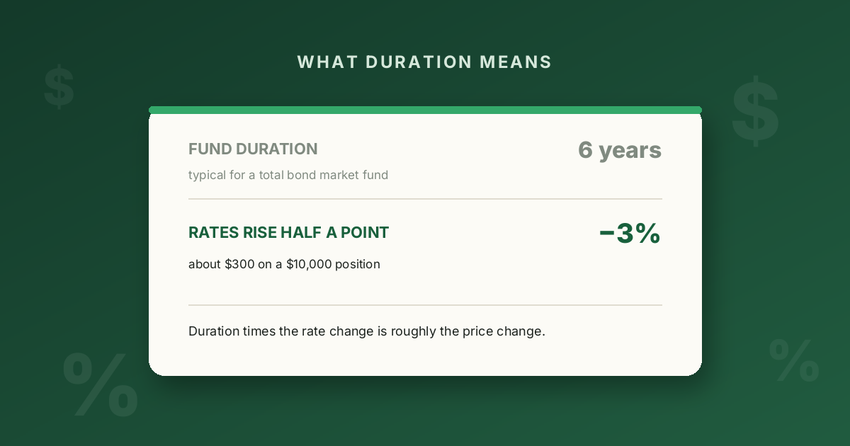
Duration is a number, expressed in years, that estimates how sensitive a bond (or bond fund) is to a change in interest rates. A rough rule of thumb: for every 1 percentage point that rates move, a bond's price moves roughly the opposite direction by a percentage equal to its duration.
So if a fund has a duration of 6 years and rates rise by 0.5 percentage points, you'd expect its price to fall by roughly 6 × 0.5 = 3%. On a $10,000 position, that's about a $300 paper loss, before counting whatever interest income the fund pays out along the way. That's an approximation, not an exact formula — it assumes rates across all maturities move together by the same amount, which they rarely do exactly — but it's close enough to explain the size of the move you're seeing.
The iShares Core U.S. Aggregate Bond ETF (AGG), one of the most widely held bond funds, currently carries an effective duration of roughly 6 years. That's why a fund holding "safe" government and investment-grade bonds can still swing meaningfully when the Fed moves rates — the underlying bonds haven't gotten riskier in the credit-default sense, they've just repriced against a new interest rate environment.
Why duration is a range, not a fixed law
It's tempting to plug the Fed's 2022 rate hikes into that rule of thumb: the Fed raised its benchmark rate by more than 4 percentage points that year, and 6 × 4 would "predict" a 24% loss. But the actual index fell about 13%, and the reason is that the Fed's overnight rate isn't the rate that matters here. What moves a bond fund's price is the yield on bonds of the maturities it holds, and those rose much less. The 10-year Treasury yield, for example, went from roughly 1.5% to about 3.9% over 2022, a rise of around 2.4 points. Run that through a 6-year duration and you get a price drop in the low-to-mid teens, and the interest the fund kept collecting all year offset a little of it. That's close to what actually happened. The rule of thumb still isn't exact, since yields don't move evenly across every maturity and a fund's duration drifts as rates change, but used with the right rate, it explains the scale of the loss well.
What this means for how you hold bonds
None of this makes bond funds a bad investment — over any reasonably long holding period, you still collect the yield, and prices can just as easily rise if rates fall. But duration is the reason two funds that both call themselves "bond funds" can behave completely differently.
A short-term Treasury fund might carry a duration of 2 years; a long-term Treasury fund can run past 15. The short fund will barely notice a 1-point rate move. The long fund will feel it a lot. If you're holding a bond fund as the stable, low-volatility part of your portfolio — money you might need in the next year or two — a shorter-duration fund matches that goal better than a total bond market fund with a 6-year duration. If you know the exact date you'll need the money, a CD ladder takes price swings out of the picture entirely, and matching each pot of money to its time horizon is worth doing before you pick any fund at all. If you're investing for retirement decades away and reinvesting the interest, a longer-duration fund's extra swings matter less, because you have time to ride them out and you'll be buying future bonds at whatever the new, higher yields happen to be.
Before you buy a bond fund, it's worth looking up its duration the same way you'd look up an expense ratio — it's usually listed right on the fund's fact sheet next to the yield. A higher yield paired with a much longer duration isn't automatically a better deal; you're being paid partly for taking on more interest-rate risk, and knowing the number tells you how much of that risk you're actually signing up for.
Check your fund's duration, then test it against the next rate move
You can see whether duration explains your fund's moves with two numbers and a calculator:
- Find the duration. On the fund's fact sheet or website, FINRA notes it usually sits in a section labeled something like "Bond Holding Statistics" or "Portfolio Data," often as effective or average duration.
- Write down your rate-risk number. Multiply your position by the duration and by 1%. For $10,000 in a 6-year fund, that's about $600: roughly what a 1-point rise in rates would knock off the price, as an example.
- After rates move, run the test. Look up how much yields changed on bonds near your fund's maturities over the same period. The 10-year Treasury yield on FRED, linked above, is a fair proxy for an intermediate fund like AGG. Multiply that change by the duration and compare it with how much the fund's share price fell (price, not total return, since total return includes interest). If the two are in the same ballpark, the fund is doing exactly what a fund with that duration does.
- If the loss is much bigger than duration predicts, look at what the fund holds. FINRA also points out that a low duration doesn't mean low risk, because bond funds carry credit risk too. A fund full of lower-rated corporate bonds can drop for reasons that have nothing to do with rates.
Recheck the duration once a year, or whenever you're adding a lot of new money, since it drifts as rates change and the fund's holdings turn over.
Moves that turn a rate-driven dip into a real loss
- Selling right after rates jump. The price drop is the cost of rates rising; the reward is that the fund now reinvests at higher yields. Sell at the bottom and you keep the first part and give up the second. The same instinct drives selling stocks after a market drop.
- Comparing funds by name instead of by number. "Intermediate," "core," and "total" don't tell you how sensitive a fund is. Two funds with similar names can carry durations several years apart.
- Treating a bond fund like a single bond you can hold to maturity. FINRA notes that an individual bond held to maturity can largely ignore rate changes. A fund never matures, so waiting doesn't guarantee your original price comes back; what helps instead is the higher income it earns after rates rise.