
Biweekly pay — every two weeks, on a fixed day like every other Friday — is the most common schedule in the U.S. About 43% of private businesses pay that way, according to Bureau of Labor Statistics data from 2023, while just under 20% pay semimonthly (twice a month, like the 15th and the last day). Those two schedules sound almost identical. They are not, and the gap between them causes a specific, avoidable budgeting error.
26 is not the same as 24
Biweekly pay means 26 paychecks a year, because 52 weeks divided by 2 is 26. Semimonthly pay means exactly 24, because it's tied to the calendar — two payments every month, no exceptions. Most months have four weeks, so a biweekly schedule lines up with two paychecks per month most of the time. But four weeks is only 28 days, and most months run 30 or 31. Over a year, those extra days accumulate into two additional pay dates that don't fit neatly into the "two per month" pattern. The result: two months a year end up with three paychecks instead of two, purely because of how the calendar and a 14-day cycle interact — not because you worked more or got a raise.
On a 2026 biweekly schedule with a first payday of Friday, January 2, the three-paycheck months are January and July. That exact schedule has one more wrinkle this year: its next payday after December 18 falls on Friday, January 1, 2027, a bank holiday, so employers that pay before the holiday will issue it on Thursday, December 31. That gives some Friday biweekly payrolls 27 paychecks in 2026 instead of 26, something that happens about every 11 years, and makes December a third three-paycheck month. Move the first payday to January 9, and they're May and October instead. Your own three-paycheck months depend entirely on your specific payday, so the only reliable way to know yours is to mark your actual pay dates on a calendar and count.
The arithmetic mistake this causes
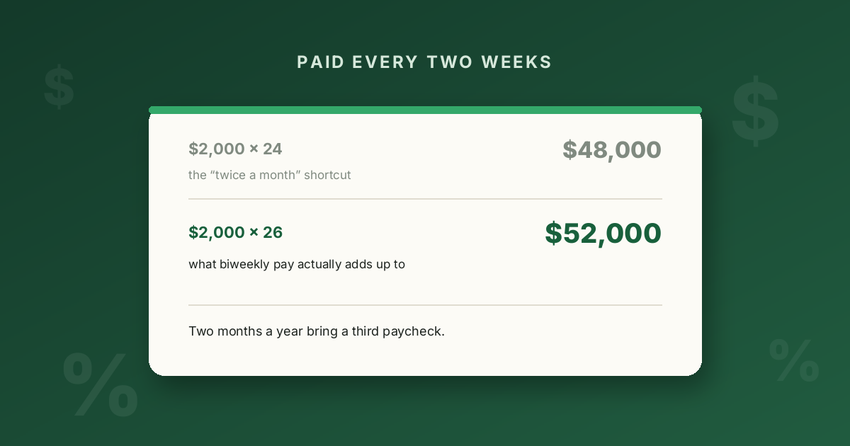
Here's where it gets costly. Say you're paid $2,000 every two weeks and you're setting up a budget, a loan application, or a budgeting app's income field. It's natural to think "I get paid twice a month" and multiply: $2,000 × 24 = $48,000 a year. That feels like a reasonable shortcut.
It's wrong by $4,000. The actual annual total is $2,000 × 26 = $52,000 — the ×24 assumption understates real income by about 7.7%, the value of two entire paychecks that quietly vanish from the estimate. Divide correctly and your true average monthly income is $4,333.33, not the $4,000 the twice-a-month shortcut implies.
This isn't a rounding error. If you're using that understated number to decide what you can afford — a car payment, rent, a subscription bundle — you're budgeting against income that's actually lower than what will hit your account, which usually just means unexplained extra cash shows up most months. That sounds harmless, but it also means your "how much can I afford" math was built on a wrong number from the start. It cuts the other way when you compare jobs, too: a $2,000 semimonthly paycheck is $48,000 a year, while a $2,000 biweekly paycheck is $52,000, so the same-looking check can mean two very different salaries.
What the third paycheck actually is
A three-paycheck month is not a bonus and it's not a raise. You still receive exactly 26 paychecks over the year no matter how they land on the calendar (27 in the rare years like the one above). The two third checks are simply the two paychecks a year that a "twice a month" budget never counted. If you spend every paycheck as it arrives, three-paycheck months feel flush and two-paycheck months feel tight, even though your annual income hasn't changed at all.
The fix that financial educators consistently recommend, including in Discover's guide for biweekly earners, is to budget by paycheck rather than by calendar month. Concretely: figure out your recurring monthly bills (if you haven't listed them yet, build the budget line by line first), divide that total by two, and treat that as your "per-paycheck" budget baseline for 10 months of the year. In the two months where a third check shows up, that extra paycheck isn't overflow — it's a paycheck you weren't counting on for regular bills in the first place, so it's available in full for something specific: an extra payment toward whichever debt your avalanche or snowball order says comes first, a top-up to an emergency fund, or a lump-sum contribution to a retirement account.
Mistakes that make the third paycheck disappear
Two mistakes show up most often. The first is the income-estimation error above — using ×24 instead of ×26 when filling out a budget, a lease application, or a budgeting app that asks for "monthly income" as a single number. The second is the opposite problem: someone unconsciously starts relying on the third paycheck to cover a recurring bill — say, a car payment due on the 28th — and then gets caught short in a month where that bill lands before payday because the biweekly cycle shifted. Putting every due date and payday on one bill calendar shows those collisions months ahead.
A third mistake is quieter: letting the extra check land in checking with no assignment. Without a specific destination, a $2,000 paycheck tends to get absorbed into a few weeks of slightly looser spending, and by the end of the month there's nothing to show for it.
All three have the same root cause: treating a 14-day pay cycle as if it were a monthly one. It mostly is, which is exactly what makes the two months a year when it isn't so easy to miss. If you're paid biweekly, the fix costs about five minutes: pull up your last few pay stubs, mark the actual dates on a calendar for the year ahead, and note which two months carry three. Everything else — the per-paycheck budgeting, the plan for the extra check — follows from knowing that up front instead of noticing it by surprise when your account balance looks unusually good.
Check your count against your pay stub
Your pay stub is the easiest place to confirm the math. Find the year-to-date gross pay and divide it by the gross pay for a single period. On a biweekly schedule, the result tells you how many paychecks you've received so far this year. As an example, if your year-to-date gross is $36,000 and each check's gross is $2,400, you're on paycheck 15, and the stub for your last check of the year should land at 26 (27 if you're on one of the Friday schedules described above).
Then check the income figure your budget actually uses. If your app or spreadsheet asks for monthly income, it should be your net pay per check times 26, divided by 12: $4,333.33 for a $2,000 check, not $4,000. If it lets you enter income per paycheck instead, use that.
Finally, check the month after each three-paycheck month. Whatever you assigned the extra check to should show it: a debt balance about $2,000 lower, or a savings or retirement balance about $2,000 higher. If instead your checking account just looked fuller for a couple of weeks and then drifted back down, the paycheck leaked into everyday spending, and next time it needs to move on payday.