
Car insurance, streaming services, gym memberships, domain registrars — a lot of recurring bills quietly offer two prices: one if you pay monthly, and a lower one if you pay for the whole year at once. Most people either ignore the annual option because the upfront number looks bigger, or take it automatically because "saving money" sounds like it's always the right call. Neither reaction involves doing the actual math, and the math is worth five minutes.
The discount is usually real, and bigger than it looks
Many auto insurers take roughly 5% to 9% off your premium for paying in full (GEICO and Progressive advertise up to 8% and 9%), and on top of that they charge installment fees of $3 to $10 per payment on monthly plans, according to MoneyGeek's comparison of monthly and annual car insurance payments. Those fees alone can add $36 to $120 a year to a policy you're paying monthly, on top of losing the pay-in-full discount.
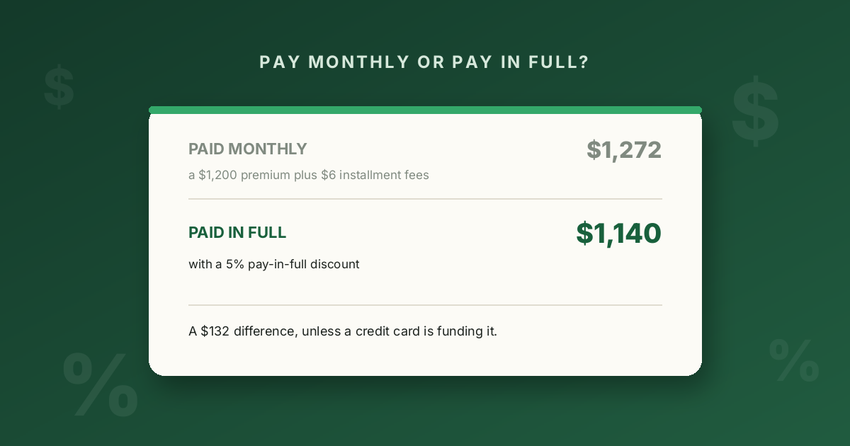
Run the numbers on a $1,200 annual premium: paid monthly with a $6 installment fee, you're paying $106 a month, or $1,272 for the year. Paid in full with a 5% discount, the same coverage costs $1,140. That's a $132 difference — about 10% of what the monthly payer spends, for making one decision differently.
Subscription services follow a similar pattern, just with bigger percentage gaps. Annual plans commonly run 15% to 20% cheaper than paying month to month, and sometimes more — a $10-a-month service billed annually at $90 works out to a 25% discount versus the $120 you'd pay across twelve monthly charges. Life insurers offer smaller but still real discounts, typically 3% to 5% for annual billing, per Policygenius.
What paying upfront actually costs you
The discount isn't free, though — you're giving something up to get it, and that something is the use of your own cash for the rest of the year. If that $1,200 would otherwise have sat in a high-yield savings account earning 4% while you paid it down $100 a month, the money you hand over in January would have kept earning interest a little longer if you'd spread the payments out instead.
Working through that scenario month by month — withdrawing $100 from a 4% APY account at the start of each month instead of all $1,200 upfront — the monthly payer earns roughly $22 in interest over the year on the declining balance. That's real, but it's small next to the $132 the annual payer saves in discount and avoided fees. Even after accounting for the lost interest, paying annually comes out about $110 ahead in this example. For most people with the cash already sitting in a bank account, the opportunity cost argument against paying annually doesn't hold up; the discount wins by a wide margin.
Where the math flips
The picture changes if that upfront payment doesn't come from money already sitting idle — if paying it means carrying a balance on a credit card instead. Credit card APRs commonly run 20% to 25%; the Federal Reserve's average rate on card accounts that were actually charged interest was 21.52% in February 2026. If covering that same $1,200 premium means carrying an average balance of $600 on a card at 24% APR for the year while you catch up, that's roughly $144 in interest — more than wiping out the $132 you saved by paying annually in the first place.
This is the case that trips people up, because "get a discount for paying annually" sounds like unambiguous good advice, and it usually is a good deal, right up until funding it means paying interest at a much higher rate than the discount itself is worth. A 5% pay-in-full discount is not a good trade against 24% credit card interest. A 20% subscription discount might still be, but it's worth checking the actual numbers rather than assuming.
There's a second version of this same trap: paying annually for something you might cancel partway through. If you commit to a year of a service and stop using it in month four, you've locked in eight months of a cost you're no longer getting value from, and the discount you "saved" doesn't cover that. A reasonable rule is to only move something to annual billing once you've used it steadily for a few months and expect to keep using it.
Mistakes that turn the discount into a loss
- Draining your emergency fund to pay it. The math above assumes the cash was sitting idle. If paying $1,140 in January leaves your cushion thin and a $900 car repair lands in March, that repair goes on a card at 24%, and you've rebuilt the financing problem from the back door.
- Assuming the annual price is locked in for good. Insurance premiums are re-rated at every renewal, and many annual subscriptions renew automatically at whatever the price is then. The discount you calculated applies to this term only.
- Skipping the cancellation terms. Many insurers refund the unused part of a prepaid premium if you cancel or switch carriers, sometimes minus a fee, while many subscriptions refund nothing once the year is paid. Know which kind you're buying before you prepay.
A quick way to decide
Before switching a bill to annual billing, ask two questions. First, does the money for the lump sum already exist in an account you're not otherwise using for something better — an emergency fund cushion, a checking buffer? If yes, the annual discount is close to free money, since the interest you'd give up is small compared to the discount and avoided fees. Second, would you have to put the payment on a card and carry a balance to cover it? If yes, compare dollars, not percentages. Because you pay the card down over the year, your average balance is only about half the payment, so the interest is roughly the APR times half the premium. If that's more than the discount and fees you'd save, monthly billing is actually the cheaper option once financing costs are counted, and any spare cash does more good paying down that card balance. If the lump sum just doesn't exist yet, you don't have to choose between the card and the monthly surcharge forever: a sinking fund that sets aside $95 a month ($1,140 divided by 12) has next year's paid-in-full premium ready by renewal.
Insurance and subscriptions aren't the only places this shows up — domain names, professional certifications, and some property tax and HOA arrangements all offer similar monthly-versus-annual choices. The underlying question is always the same one: is the discount bigger than what it costs you to have the cash available all at once? For most people with a stable emergency fund and no revolving credit card balance, the annual option is worth taking almost every time. For anyone financing the difference at credit card rates, it's worth running the numbers before assuming the "discount" is actually a discount.
Check that the savings actually landed
After you pay, confirm the discount was applied rather than assumed:
- Insurance: open the billing or payments page of your policy account. A paid-in-full policy should show a $0 remaining balance for the term and no future installment dates, and many insurers list the pay-in-full discount as its own line on the bill or declarations page. If you still see a schedule of upcoming payments, your lump sum may have been treated as a down payment, so call and ask.
- Subscriptions: the annual charge on your card or bank statement should match the annual price you were quoted, and the following month's statement should show no monthly charge from the same company.
- The dollar check: compare what you paid with 12 times the monthly price plus any installment fees. In the insurance example, that's $1,140 against $1,272. If the gap is smaller than you expected, find out why before the next renewal.
- If you used a card: the next statement's interest charged line should read $0. Any interest there means you've slipped into the financed version of this trade.
Then put the renewal date on your calendar with a reminder a month ahead. That's the moment to compare the new annual price against the monthly option again, and to ask whether you still use the thing at all. It's the same review that catches subscription creep before it renews for another year.