
Buying physical gold or silver is the easy part. You pick a dealer, pay the spot price plus a premium, and the coins or bars show up. What a lot of first-time buyers skip is the question of what happens if that box gets stolen, burns in a fire, or otherwise disappears — and the answer, for most people, is that their homeowners or renters policy barely covers it at all.
The sublimit nobody reads
Standard homeowners policies don't treat bullion and coins like ordinary personal property. They carve it out into a "special limits of liability" category with its own cap, separate from and much lower than your overall coverage. Under the widely used ISO HO-3 policy form, money, bullion, coins, and gold, silver, and platinum (other than goldware and silverware) are capped at $200 total. That cap applies no matter how the loss happens, so it's $200 whether your coins are stolen or lost in a fire. Jewelry gets its own, separate limit, typically $1,500 for theft, which is why gold jewelry and gold coins can be covered very differently under the same policy. JM Bullion's guide to homeowners insurance and precious metals walks through the same limits from a buyer's point of view.
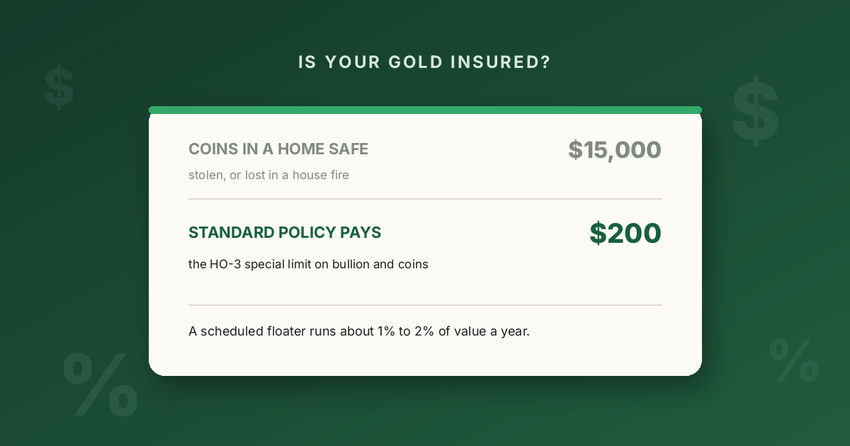
Run the numbers on a modest position: $15,000 in gold and silver coins, kept in a home safe. If it's stolen, or lost in a house fire, a standard policy's $200 bullion sublimit covers about 1.3% of the loss. The other 98.7% is yours to absorb. That's not a small print detail — it's most of the point of owning the metal in the first place, undone by a policy you probably never read past the declarations page.
This isn't a hypothetical made urgent only by insurers trying to sell add-ons. CNBC reported in December 2025 that jewelry owners should revisit their coverage because gold's price run has left many collections underinsured on old appraisals and old policy limits. The same logic applies even more to coins and bars: a $200 sublimit written into a policy years ago didn't get more generous just because spot prices moved.
Why the bank vault isn't a clean fix either
The obvious workaround — move it to a safe deposit box — solves the "someone breaks into my house" problem but creates a different gap. Safe deposit box contents aren't insured by the bank, and they aren't FDIC-insured either; the FDIC's own consumer guidance is direct about this, listing it as one of five things people misunderstand about safe deposit boxes and home safes. FDIC insurance protects deposit accounts — checking, savings, CDs — not physical items sitting in a box, however secure the vault around it looks. If a box is flooded, or a bank employee makes an error, or a box is drilled during a break-in, the bank's liability is often limited or disclaimed outright in the rental agreement you signed without reading closely.
So a safe deposit box changes your risk profile — lower chance of theft, since it's not in your house — but it doesn't add insurance. You still need coverage on the contents, and that coverage has to come from somewhere other than "the bank has a vault."
The actual fix, and what it costs
The standard way to close this gap is a scheduled personal property endorsement, sometimes called a personal articles floater. Instead of relying on your policy's blanket personal-property limit and its special sublimits, you list the specific items — coins, bars, a jewelry piece — at an appraised or invoiced value, and the insurer agrees to pay that stated amount on a covered loss, usually with no deductible and a broader list of covered perils than a standard policy provides.
The cost is genuinely reasonable relative to what it protects. Insurance.com and several agency sources put the typical rate at roughly 1% to 2% of the item's value per year. On that $15,000 coin position, that works out to $150 to $300 a year — for full replacement value coverage instead of a $200 sublimit. On a smaller starter stack worth $4,000, the same math comes out to $40 to $80 a year. Either way, it's a small, predictable cost next to the alternative of a five-figure loss covered by a $200 line item.
A few practical notes if you're setting this up. Insurers generally want an appraisal, a dealer invoice, or dated photographs as proof of value and existence — keep your purchase receipts regardless of how you end up storing the metal, since you'll need them either to file a claim or to establish your cost basis for the tax bill when you eventually sell. Ask explicitly whether the policy pays out in cash or will replace the metal in kind; the difference matters if gold has moved a lot between when you bought it and when you'd have to replace it. And if you split your holdings between a home safe and a bank box, tell the insurer that too — some floaters price differently, or exclude coverage, depending on where the item actually sits day to day.
How to check what your policy pays for your metal today
The declarations page alone won't tell you, so this takes two documents and about fifteen minutes:
- Find the special limits in the policy form. In your full policy (the long document, not the one-page summary), look in the property coverage section for a heading like "special limits of liability." Find the line covering money, bullion, and coins, and write down the dollar figure. That number, not your overall personal property limit, is what a stolen or burned stack is worth to your insurer today.
- Look for the endorsement on your declarations page. If you've added scheduled coverage, the declarations page should list the endorsement by name, and its schedule should show each item or class (coins, bars) with a dollar amount next to it. No endorsement listed means you're still on the sublimit.
- Compare the scheduled amount with today's value. Multiply the ounces you own by the current spot price. If you scheduled $15,000 when you bought and the metal is now worth $18,000, $3,000 of it is uninsured. Some insurers will update the schedule from a current dealer quote; ask what they accept.
Check again at every renewal, after any purchase, and after any big price move, since the schedule doesn't update itself.
Mistakes that leave the gap open
- Raising your overall personal property limit and assuming that fixes it. The special limit for bullion is a separate line. Doubling your total contents coverage leaves the $200 cap exactly where it was.
- Scheduling at purchase price and never revisiting it. A floater pays the amount on the schedule. If gold has climbed since you bought, the policy pays the old number.
- Keeping your receipts in the same safe as the metal. A fire that takes the coins takes the proof of value with them. Keep copies in cloud storage or somewhere off-site, along with dated photos.
- Taking bars out of their original assay packaging. Sealed packaging with an assay card is part of your proof of what you own, and it matters again when you sell or need to show the metal is genuine.
None of this requires exotic insurance products or a private vaulting service, though those exist for larger holdings. For most beginners with a few thousand to a few tens of thousands of dollars in physical metal, a scheduled endorsement added to an existing homeowners or renters policy is the ordinary, unglamorous step that actually matches your coverage to what you own. Buying the metal was the visible decision. Insuring it properly is the one that's easy to skip and expensive to have skipped.