
You will probably never receive a bill for the fees on your index fund or mutual fund. There's no invoice, no line item on a bank statement, no email reminder. The fund simply skims its expense ratio off the top every single day, shaving it out of the fund's net asset value before you ever see a return. That invisibility is exactly why so many beginner investors never think about it — and why it quietly does more damage to long-term returns than almost any other decision they'll make.
What an expense ratio actually is
An expense ratio is the percentage of your investment that a fund charges each year to cover management, administration, and operating costs. If a fund has a 0.50% expense ratio and you hold $10,000 in it, you're paying roughly $50 a year — not as a separate charge, but built into the fund's daily pricing. The SEC's investor bulletin on fund fees explains that these costs are deducted from fund assets before performance is ever reported to you, which is part of why they're so easy to ignore.
The gap between fund types is bigger than most people expect. According to the Investment Company Institute, the average index equity mutual fund charged just 0.05% in 2025, while the average actively managed domestic equity mutual fund charged 0.64% — more than twelve times as much. Index equity ETFs averaged 0.14%, per ICI's 2025 fee report — still a fraction of what the typical active fund charges.
None of that guarantees the cheaper fund performs better in any given year. But the fee itself is guaranteed, win or lose, every year you hold the fund.
The math that makes this matter
Fees compound the same way returns do, just in the wrong direction. Every dollar a fund takes this year is a dollar that isn't there to grow next year, and the year after that, for as long as you stay invested. Small percentages turn into large dollar amounts because they're applied to a balance that keeps getting bigger.
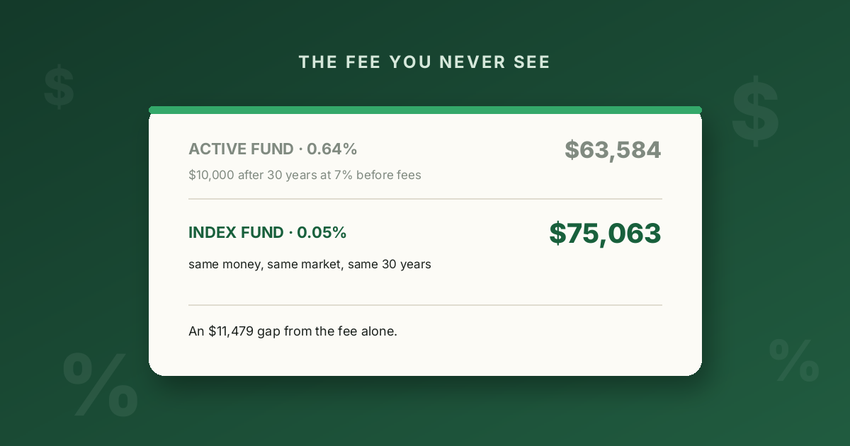
Here's a simple example. Put $10,000 into a stock fund, never add another dollar, and assume the underlying investments earn 7% a year before fees for 30 years:
- In a fund charging 0.05%, you'd end up with about $75,060.
- In a fund charging 0.64%, you'd end up with about $63,580.
- In a fund charging 1.00%, you'd end up with about $57,440.
Same money, same market, same 30 years. The only difference is the fee, and it's worth roughly $11,500 between the first two funds — more than the entire amount you invested. The SEC ran a similar illustration in its investor bulletin on mutual fund fees: $100,000 earning 4% a year for 20 years grows to about $208,000 with 0.25% in annual expenses, but only about $179,000 with 1.00%.
And that's a single lump sum. If you're contributing every month for decades, the fee is taken from every one of those contributions too. To run this kind of projection on your own balance, the same tools apply as in running compound interest numbers on your savings: just subtract the fee from the return before you compound.
Why a higher fee rarely pays for itself
The argument for paying more is that an actively managed fund's professional stock-pickers will earn enough extra return to cover their cost. Some do, in some years. The problem is that the fee is certain and the outperformance isn't. A fund charging 0.64% has to beat its benchmark by more than half a percentage point every year just to break even with a comparable index fund — and it has to keep doing it for as long as you own it.
That's why so much money has shifted toward low-cost index funds over the past few decades. ICI reports that average expense ratios for equity mutual funds have fallen 62% since 1996, largely because investors kept moving to cheaper options. For a beginner, the lesson is simple: a low fee isn't the only thing that matters, but it's the one thing about a fund's future you can actually know in advance.
How to find what you're paying
You don't need to read a full prospectus to check this. A few quick places to look:
- The fund's page on your brokerage site. Search the ticker and look for "expense ratio" or "net expense ratio" in the summary.
- Your 401(k) plan's fund list. Plan websites list each investment option's expense ratio, and the annual fee disclosure your plan sends out has the same numbers.
- The fund's fact sheet. It's usually a one- or two-page PDF linked from the fund company's site, with the expense ratio near the top.
When you compare, compare like with like: a U.S. total-market index fund against another U.S. total-market index fund, not against a specialty sector fund. If two funds hold essentially the same investments, the cheaper one starts every year with a head start.
What to do if your fees are high
If you find you're paying 0.75% or more for a broad stock fund, you don't necessarily need to act overnight — but it's worth a look. Inside an IRA or 401(k), switching funds doesn't trigger taxes, so moving to a lower-cost option in the same asset class is usually straightforward. In a regular taxable brokerage account, selling a fund that's gained value can create a tax bill, so it may make sense to direct new contributions to a cheaper fund first rather than selling everything at once. High-cost active funds held in taxable accounts can also generate capital gains distributions you owe tax on even in a down year, which is one more reason to keep them out of taxable money.
In a 401(k), your choices are limited to what your plan offers, but most plans now include at least one low-cost index fund. It's often listed plainly as an "index" or "S&P 500" option, and it's frequently the cheapest thing on the menu.
Here's a hypothetical 401(k) to make it concrete. Alex has $40,000 in the plan: $25,000 in an S&P 500 index fund charging 0.04% and $15,000 in a large-cap active fund charging 0.85%. That's $10 a year on the index fund and $127.50 on the active fund, so $137.50 in total. Divide by $40,000 and Alex's blended expense ratio is about 0.34%. Move the $15,000 into the index fund, and the annual cost drops to $16, a blended 0.04%. That's about $120 a year saved now, and the gap grows as the balance does.
Confirm the switch actually happened
Changing funds in a 401(k) often involves two separate settings, and it's common to change one and assume you changed both. After you make a switch, check:
- Your future contribution election. This controls where new paycheck contributions go. It should list the low-cost fund at the percentage you chose.
- Your existing balance. Moving money you've already saved is a separate transaction, often called an exchange, transfer, or rebalance. Your holdings page should show the old fund at zero (or the amount you meant to keep) within a few business days.
- Your next statement. It should show a sale of the old fund, a purchase of the new one, and your next contribution landing in the new fund.
- Your blended expense ratio. Redo the math above with your new holdings. If it hasn't dropped, something didn't go through.
Check again each year when your plan sends its annual fee disclosure, because plans sometimes swap funds or share classes, and a fund's expense ratio can change.
Fee mistakes that survive a fund switch
- Changing future contributions but not the existing balance. Your new money goes to the cheap fund while years of savings keep paying the old fee. Check both settings.
- Reading the net expense ratio without checking for a waiver. Some funds show a low “net” ratio because the company is temporarily waiving part of its fee. The fee table in the prospectus shows the gross ratio and when any waiver ends.
- Ignoring costs that aren't in the expense ratio. Sales loads, which some funds charge when you buy or sell, aren't included, as the SEC's investor bulletin on fund fees explains. Neither are advisory or account fees charged on top of your funds.
- Selling a winner in taxable just to save a few basis points. A large capital gains bill can take years of fee savings to earn back. Redirect new money first and run the tax math before you sell.
- Picking the cheapest fund on the menu regardless of what it holds. A cheap bond fund isn't a substitute for a stock fund. Compare costs within the same kind of investment, then think about which account each fund belongs in.
The bottom line
You can't control what the stock market does next year. You can control what you pay to be invested in it. Checking your expense ratios takes about ten minutes, and for a lot of beginning investors it's the single highest-value ten minutes they'll spend on their portfolio this year.