
Most beginner savings advice sorts your money into two buckets: cash you might need any second (emergency fund, high-yield savings account) and money you won't touch for decades (retirement accounts). There's a gap in between that nobody talks about much — money you know you'll need, just not right now. A wedding in 18 months. A car you're planning to buy in two years. A kitchen renovation you're saving toward for three.
That gap is exactly what a CD ladder is built for.
The problem a ladder actually solves
A single certificate of deposit is a trade: you agree not to touch your money for a set term — six months, one year, five years — and the bank pays you a higher, locked-in rate in exchange. The catch is obvious. Lock up $10,000 for three years and something comes up in month eight, and you're stuck either eating an early withdrawal penalty or leaving the money where it is.
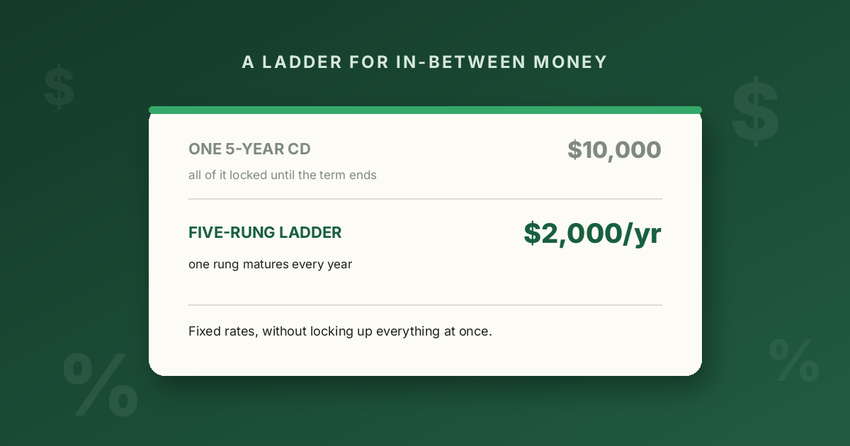
A ladder fixes that by splitting the money instead of locking all of it at once. You might put $2,000 each into a 1-year, 2-year, 3-year, 4-year, and 5-year CD instead of $10,000 into a single 5-year CD. One rung matures every year, so you're never more than about twelve months from having some portion of the money free, while the rest is still earning the higher rate that longer terms usually pay. Bankrate's guide walks through this staggered-maturity structure in more detail, and it's the same logic whether you're laddering across five years or compressing the whole thing into six- and twelve-month rungs for a shorter goal.
Why this isn't just "a savings account with extra steps"
The honest case for a CD ladder right now is narrower than it sounds. As of this September, top high-yield savings accounts are paying around 4.2% APY, according to NerdWallet's rate survey, while the best CDs are paying roughly 4% to 4.5%, per Bankrate. That gap is small, and on some terms it disappears.
What you're really buying with a CD is certainty. A savings account's rate is variable: the bank can raise it or cut it whenever it likes, usually following the Federal Reserve. A CD's rate is fixed for the whole term, no matter what happens to interest rates in the meantime. A ladder gives you that certainty on most of your money, while still handing some of it back to you every year, and each time a rung matures you reinvest it at whatever rates are available then. If rates have gone up, you get the benefit. If they've gone down, the rest of your ladder is still locked in at the older, higher rates. That matters because a savings account's rate can fall at any time, and your bank doesn't have to warn you before it does.
Building a ladder around a real goal
The classic five-year ladder is built for ongoing savings. For a specific goal, you can shape the ladder around the date you'll need the money.
Say you're saving $9,000 for a wedding 18 months from now, and you'll need to pay deposits along the way. You could split it into three rungs: $3,000 in a 6-month CD, $3,000 in a 12-month CD, and $3,000 in an 18-month CD. Each one comes due roughly when a chunk of bills is due, and none of the money sits idle in a checking account in the meantime.
Here's what that earns, using hypothetical rates of 4.10% APY on the 6-month CD, 4.20% on the 12-month, and 4.00% on the 18-month:
- 6-month rung: about $61 ($3,000 earning 4.10% for half a year).
- 12-month rung: about $126 ($3,000 × 4.20%).
- 18-month rung: about $182 ($3,000 earning 4.00% for a year and a half, with interest compounding).
That's roughly $369 over the 18 months. The same $9,000 left in an interest checking account at the FDIC's September 2026 national average of 0.07%, per its national rates release, would earn under $10. Working out how much to set aside each month to hit a dated goal like this is its own skill; here's how to turn a big goal into a monthly budget line.
A few practical points when you set one up:
- Check the minimum deposit. Many banks ask for $500 to $1,000 to open a CD, and some have no minimum at all, so a ladder is realistic even with modest savings.
- You don't need one bank. Each rung can go wherever the rate is best for that term. Just keep a simple list of what matures when.
- Watch the maturity date. Most banks automatically roll a matured CD into a new one of the same term unless you tell them otherwise. You usually get a short grace period after maturity, often around a week to ten days, to withdraw or move the money without a penalty. Put the dates on your calendar.
Know the early withdrawal penalty before you open one
Every CD spells out what happens if you need the money early, and it's usually a set number of months of interest. According to Bankrate, penalties typically range from about three to twelve months of interest, with longer terms carrying bigger penalties. Some banks charge only a month or so of interest on very short CDs and a full year's worth on terms of two years or more.
Run the numbers before you sign. Take the hypothetical 12-month rung above: $3,000 at 4.20% with a three-month interest penalty. The penalty is $3,000 × 4.20% × 3/12 = $31.50. Break the CD after ten months and you've earned about $105, so you keep around $73 of interest. Break it after two months and you've earned only about $21, so the penalty is bigger than your interest, and at many banks the difference comes out of your original deposit.
The penalty is the reason a ladder is a tool for money you've already planned for, not for surprises. If you think there's a real chance you'll need a chunk of money before a rung matures, a no-penalty CD, which lets you withdraw after a short initial window without paying anything, can be a middle ground, though it usually pays a slightly lower rate.
Is the money safe?
CDs at FDIC-insured banks (or NCUA-insured credit unions) are covered the same way savings accounts are: up to $250,000 per depositor, per insured bank, for each account ownership category. One thing to keep in mind is that the limit counts all your deposits at the same bank together, so your CDs, savings, and checking at one bank share that $250,000. For most beginners that's not a concern, but it's another good reason to spread rungs across banks if your balance grows.
Check each rung after you open it
A ladder only works if every rung is set up the way you planned. Within a day or two of opening each CD, log in and confirm:
- The APY and term match what you were quoted. Your account details or opening disclosure should show both.
- The maturity date lands where you need it. For the wedding ladder, that's roughly 6, 12, and 18 months out, a little before each batch of bills.
- The maturity instructions. Many banks let you choose “renew” or “transfer to savings at maturity.” If the money is earmarked for a bill, pick the transfer.
- The early withdrawal penalty in the account agreement, written as a number of days or months of interest.
Then keep a simple list: bank, amount, rate, maturity date. When each maturity notice arrives, usually a few weeks ahead, compare it to your list and decide what to do before the grace period ends. Each January, expect a tax form from every bank for the interest credited that year, even on a CD that hasn't matured yet. CD interest is taxable as you earn it, not only when you cash out.
Ladder mistakes that cost more than they earn
- Letting a rung auto-renew without looking. The renewal is often at the bank's standard rate for that term, which can be well below the promotional rate you got the first time. Shop the rate before the grace period ends.
- Putting money you might need soon on a long rung. As the example above shows, breaking a CD early can cost more than the interest it earned. Match each rung to a date you're confident about.
- Treating brokered CDs like bank CDs. CDs bought through a brokerage usually can't be cashed in early with a set penalty. You have to sell them, and the SEC warns that you may lose some of your principal if rates have risen since you bought.
- Chasing a rate without checking the insurance. A great rate from an institution you've never heard of is fine if it's FDIC- or NCUA-insured. Confirm that before you send money.
- Locking everything long for an extra tenth of a percent. A 5-year CD paying a hair more than a 1-year CD isn't much of a reward for tying up money you may want sooner.
When a ladder isn't the right tool
A CD ladder is not a replacement for an emergency fund. Money for a job loss or a surprise car repair needs to be available the same day, which is why it belongs in a high-yield savings account, not behind a penalty. And for money you won't need for ten years or more, a ladder is usually too conservative, because CDs are designed to protect money, not grow it the way a diversified investment portfolio can over long stretches.
Where a ladder shines is the in-between money: goals one to five years out, where you want a better rate than a savings account might pay, but can't afford the risk of the stock market dropping right before you need the cash. If you're already using I Bonds for part of that bucket, a CD ladder can sit alongside them without a 12-month lockup on every dollar.
The bottom line
A CD ladder isn't complicated, and it isn't exciting. It's just a way of matching your savings to your calendar: lock in a fixed rate on money you know you won't need yet, and arrange things so that some of it frees up on a schedule. If you have a goal with a date on it, that's usually all a savings plan needs to be.