
Two people can own the exact same mix of stocks and bonds — say, 70% in a total stock index fund and 30% in a bond fund — and end up with meaningfully different amounts of money in their pockets after taxes, purely because of which account each fund sits in. One person parks the bond fund in a Roth IRA and the stock fund in a regular taxable brokerage account. The other does the opposite. Same investments, same returns before tax, different outcome. That gap is what financial planners call asset location, and it's a step most beginners never learn about because it only becomes relevant once you have more than one type of account to work with.
The Tax Treatment Isn't the Same for Every Kind of Return
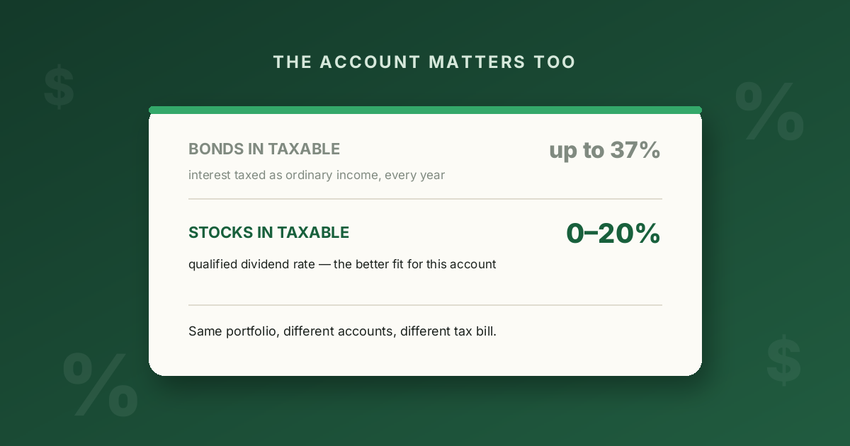
Bond interest and REIT (real estate investment trust) distributions get taxed as ordinary income, at rates that top out at 37% for high earners. Stock dividends, by contrast, are often "qualified," meaning they get taxed at the lower long-term capital gains rates — 0%, 15%, or 20% depending on income. REIT dividends specifically don't usually qualify for that lower rate, because REITs don't pay corporate income tax themselves, so their payouts skip the step that normally earns the preferential treatment, and end up taxed as ordinary income too, according to Savvy Wealth.
For 2026, a single filer with taxable income under $49,450 pays 0% on qualified dividends and long-term gains; income up to $545,500 gets taxed at 15%; above that, 20%, per figures reported by Kiplinger. Compare that to ordinary income brackets that reach 37%, and the gap between "qualified" and "ordinary" treatment is the entire reason asset location matters.
The General Rule
Put the tax-inefficient stuff — bonds, REITs, actively-traded funds that kick off a lot of short-term gains — inside tax-advantaged accounts like a 401(k), Traditional IRA, or Roth IRA, where the IRS never sees the annual interest or dividends at all. Put the tax-efficient stuff — broad stock index funds, which pay mostly qualified dividends and rarely distribute gains — in a regular taxable brokerage account, where the lighter tax treatment does the least damage. Actively managed funds are a double problem in a taxable account: besides higher fees, they're the ones most likely to hand you a capital gains distribution even in a year the fund lost money.
Running the Numbers on One Portfolio
A worked example: $100,000 split 70/30 between a stock index fund and a bond fund, held for a year. In the "bonds in taxable, stocks sheltered" arrangement, roughly $1,500 of bond interest gets taxed at a high earner's 37% ordinary rate — about $555 in tax, paid every single year the position is held. Flip the accounts, and that same bond interest sits inside a 401(k) untaxed until withdrawal decades later, while the stock fund's qualified dividends in the taxable account get taxed at 15% or 20% instead of 37%.
To finish the math, assume (as an example) the stock fund yields 1.3% in qualified dividends. That's $70,000 × 1.3% = $910 a year. Someone in the 37% bracket is well past the 20% threshold, so:
- Bonds in taxable: $1,500 × 37% = $555 a year.
- Stocks in taxable: $910 × 20% = $182 a year.
That's about $373 a year saved, for the same portfolio. The 3.8% net investment income tax that applies at high incomes would add to both bills, so it doesn't change which arrangement wins.
The gap shrinks at middle incomes but doesn't disappear. For someone in the 22% bracket who pays 15% on qualified dividends, it's $1,500 × 22% = $330 versus $910 × 15% = $136.50, or about $194 a year. And the savings repeat every year, on a balance that's usually growing.
Where This Breaks Down
Asset location only helps if you actually have multiple account types to spread across — a taxable brokerage account plus at least one tax-advantaged one. If everything you own sits in a single 401(k), there's no location decision to make; it all grows tax-deferred regardless of what's inside it. If you're still choosing which accounts to open and fund first, start with the 401(k) match, Roth IRA, or brokerage order of operations. It also matters less the smaller the tax-inefficient slice of your portfolio is — someone holding 90% stocks and 10% bonds has less to gain from optimizing the bond placement than someone running 50/50.
It's also not a reason to change your actual asset allocation. Asset location is about where you hold a given mix of investments, not what that mix should be — decide the stock/bond split first based on your goals and risk tolerance, then use location to reduce the tax drag on whatever you land on.
Read Your 1099s to See If It's Working
You can confirm your setup in about ten minutes each February, when your taxable brokerage account sends its tax forms. Only the taxable account matters here, since IRAs and 401(k)s don't generate these forms for annual income.
- Form 1099-DIV, box 1a vs. box 1b. Box 1a is total ordinary dividends; box 1b is the qualified portion. If your taxable account holds broad stock index funds, most of 1a should show up in 1b. A big gap means something tax-inefficient is in there.
- Form 1099-INT, box 1. This is taxable interest. If you've moved your bonds into tax-advantaged accounts, this number should be small, mostly interest on cash.
- Form 1099-DIV, box 2a. Capital gain distributions. Index funds rarely produce much here; a large figure points to an actively managed fund worth relocating.
Then check the allocation itself. Add up every account and confirm the combined stock/bond split still matches your target. Your taxable account might be 100% stocks and your 401(k) mostly bonds, and that's fine as long as the total is right. Recheck once a year, or whenever you open a new account type.
Moves That Undo the Benefit
- Selling appreciated funds in taxable to relocate them. The tax bill from realizing years of gains can wipe out a decade of location savings. Instead, point new contributions where you want them, and do your rebalancing inside the tax-advantaged accounts, where trades don't create a tax bill.
- Putting municipal bonds in an IRA. Muni interest is already exempt from federal tax, so sheltering it wastes the shelter. Munis, if you use them at all, belong in taxable.
- Treating Roth and traditional space as identical. Everything in a Roth comes out tax-free, so it's the best home for the investments you expect to grow the most. Bonds usually fit better in a traditional 401(k) or IRA, leaving Roth space for stocks.
- Judging each account's mix separately. Panicking that your brokerage account is “too aggressive” and adding bonds there undoes the whole strategy. Look at the total.
- Locking near-term money in retirement accounts for tax reasons. If part of your bond allocation is money you'll need in a few years, it may have to live in taxable regardless. Access comes before tax optimization.
Fees and taxes are the two costs you can actually control, and they stack. Putting a fund in the right account doesn't help much if the fund itself is expensive, so pair this with a look at what your funds charge in expense ratios.
None of this requires trading more or picking different investments. It's a one-time decision about which account holds which fund, and it can meaningfully change how much of your return you actually keep.