
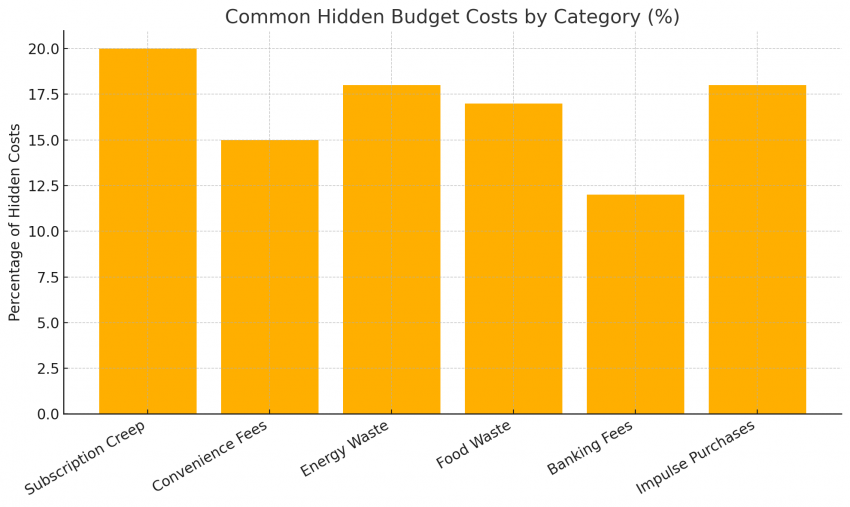
When it comes to managing your personal finances, one of the most frustrating challenges is the impact of hidden costs. These are the subtle, often overlooked expenses that slowly eat away at your budget. While you may be carefully tracking rent, groceries, and utility bills, small recurring charges, fees, and inefficiencies can quietly undermine your financial goals. In this guide, we’ll walk through how to identify hidden costs, how they show up in everyday life, and how to effectively eliminate them.
Contents
- 1 1. Understanding Hidden Costs
- 2 2. Perform a Budget Audit
- 3 3. Recognize Subscription Creep
- 4 4. Eliminate Convenience Spending
- 5 5. Control Energy and Utility Waste
- 6 6. Minimize Banking and Credit Card Fees
- 7 7. Avoid Food Waste
- 8 8. Impulse Buying and Emotional Spending
- 9 9. Use Technology to Your Advantage
- 10 10. Regularly Review Your Financial Goals
- 11 Final Thoughts
- 12 Summary Table: Hidden Cost Areas & Solutions
1. Understanding Hidden Costs
Hidden costs are expenses that don’t appear obvious at first glance. They’re often small, recurring, or bundled with larger purchases. You might not notice them until you take a deeper look at your spending habits. Common sources include subscriptions, banking fees, impulse purchases, energy waste, and even unplanned convenience spending.
Example: Sarah pays $12.99 for three separate streaming platforms but only watches one. That’s nearly $312 per year wasted on unused services.
2. Perform a Budget Audit
Start with a three-month audit of all your expenses. Use a budgeting app, bank statements, or spreadsheets. Categorize every dollar spent. Look for charges that don’t align with your values or usage.
Checklist:
- Review subscriptions (music, streaming, fitness apps).
- Identify ATM and banking fees.
- Highlight recurring payments you forgot about.
- Compare actual grocery spending with your planned budget.
Case Study: Mike conducted a quarterly review and realized he had been paying for a cloud storage account he hadn’t used in two years. Canceling saved him $120 annually.
3. Recognize Subscription Creep
Subscription creep happens when you accumulate multiple subscriptions over time. These can be music services, news apps, software licenses, or digital tools. Individually small, they collectively create a large expense.
Tip: Set calendar reminders for trial cancellations. Use a subscription tracking app like Truebill or Rocket Money.
Example: A family of four had separate Netflix, Disney+, and Hulu accounts totaling $50/month. By consolidating into one family plan, they saved $25/month or $300/year.
4. Eliminate Convenience Spending
Convenience often comes at a premium. Food delivery apps, quick stops at coffee shops, and rushed online purchases add up quickly. These aren’t emergencies—they’re habits.
Suggestion: Set a cash allowance or weekly limit for takeout and non-essential purchases. Pre-plan meals and prep snacks.
Case Study: Jenny saved $1,400 in a year by cutting her weekday coffee habit and bringing coffee from home.
5. Control Energy and Utility Waste
Hidden costs also sneak into your utility bills. Leaving lights on, using outdated appliances, or running HVAC systems inefficiently costs you more each month.
Steps to Fix:
- Install smart thermostats.
- Use LED bulbs.
- Unplug idle electronics.
- Wash clothes in cold water.
Example: The Thompsons reduced their monthly electric bill by 20% after switching to energy-efficient lighting and optimizing their HVAC schedule.
6. Minimize Banking and Credit Card Fees
Review your bank statements for overdraft charges, minimum balance fees, or interest on unpaid credit card balances. Many of these are avoidable.
Action Items:
- Switch to a no-fee checking account.
- Pay balances in full.
- Set up alerts to avoid overdrafts.
Chart Reference:
- Overdraft fees can average $35 per incident. Two overdrafts per month = $840/year.
7. Avoid Food Waste
Americans waste about 30-40% of their food. That’s wasted money too.
Strategies:
- Meal plan.
- Shop with a list.
- Freeze leftovers.
- Store food properly.
Example: A household saving $25/week by reducing waste ends up saving $1,300/year.
8. Impulse Buying and Emotional Spending
Impulse purchases are emotionally driven and unplanned. They happen in-store or online, often due to boredom, stress, or marketing triggers.
Fix:
- Use a 24-hour rule before buying non-essentials.
- Unsubscribe from marketing emails.
- Remove saved cards from shopping apps.
Case Study: Kevin cut $150/month in impulse spending by adopting a 48-hour rule and unsubscribing from promotional emails. That’s $1,800/year in savings.
9. Use Technology to Your Advantage
Budgeting apps and automation tools can help identify and cut hidden costs.
Tools to Try:
- YNAB (You Need a Budget)
- PocketGuard
- Mint
- Rocket Money
Example: Using Mint, Alex flagged a recurring $7.99 charge for an old app store subscription he’d forgotten.
10. Regularly Review Your Financial Goals
Setting financial goals helps you realign your budget with your priorities. Hidden costs are easier to cut when you see them as obstacles to your dreams.
Questions to Ask:
- Does this expense bring me closer to my goal?
- Is this worth the trade-off in time or financial freedom?
Chart Insight:
Final Thoughts
Cutting hidden costs doesn’t require drastic life changes. It’s about awareness, strategy, and small shifts in behavior. When you plug the leaks in your financial ship, you move faster toward your goals—whether that’s debt freedom, a down payment, or early retirement. A few hours of auditing and action can save you thousands of dollars annually.
Summary Table: Hidden Cost Areas & Solutions
| Category | Hidden Cost Example | Solution | Annual Savings Potential |
|---|---|---|---|
| Subscriptions | Unused services | Cancel or consolidate | $300+ |
| Convenience Spending | Coffee, delivery | Set limits, meal prep | $1,400+ |
| Utility Waste | Inefficient appliances | Smart devices, LED lights | $240+ |
| Bank Fees | Overdrafts, ATM fees | No-fee accounts, alerts | $840+ |
| Food Waste | Spoiled groceries | Meal plan, freeze, store wisely | $1,300+ |
| Impulse Buying | Online shopping sprees | Delay rule, email cleanup | $1,800+ |
Total Annual Savings Potential: Over $5,000
Save money in more ways, check us out on 📺 You Tube 📺
Check out our Media Section: 📺 Media 📺
#How to Identify and Cut Hidden Costs in Your Budget
Discover more from Grow Beyond Green
Subscribe to get the latest posts sent to your email.